
Liturgy of the Hours: A Complete Guide to the Divine Office & Catholic Breviary
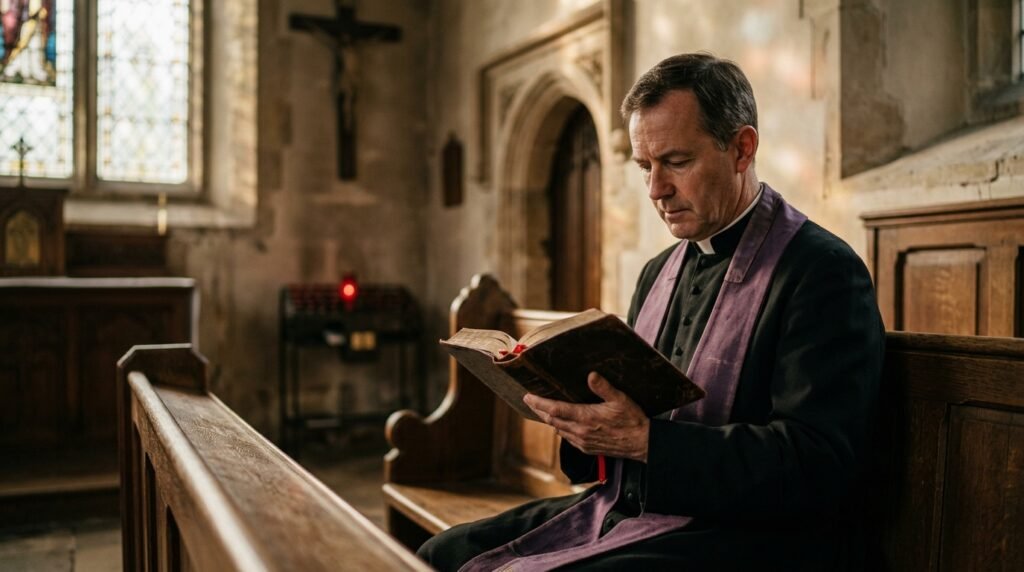
Long before books, phones, or printed missals existed, Christians already had a rhythm of prayer that followed the sun through the day. That rhythm is the Liturgy of the Hours, also known as the Divine Office, the official prayer of the Catholic Church, prayed every day by priests, religious communities, and an ever-growing number of lay Catholics who want their day to be shaped by more than just work and errands.
This guide walks you through the full structure of the Divine Office: what each hour is for, how to pray it whether you have five minutes or fifty, the traditional prayers and canticles that anchor each one, and where to find the Liturgy of the Hours online if you would rather pray from a screen than a printed breviary. Whether you are opening a Catholic breviary for the first time or you have prayed this Christian prayer for years and simply want a clear reference, everything you need is here.
In Short
The Liturgy of the Hours is the Church's official daily prayer, built around a set of fixed hours, Morning Prayer, Midday Prayer, Evening Prayer, Night Prayer, and the Office of Readings, each made up of psalms, Scripture, and set prayers that mark the passage of the day with praise.
-
What Is the Liturgy of the Hours?
- The Seven Hours of the Divine Office
- Where to Pray the Liturgy of the Hours Today
- The Invitatory: How the Day of Prayer Begins
- Morning Prayer: The Breviary's Lauds
- Midday Prayer: A Pause in the Middle of the Day
- Evening Prayer: The Breviary's Vespers
- Night Prayer: The Breviary's Compline
- The Office of Readings: The Heart of the Divine Office
- Christian Prayer: The One-Volume Breviary for Everyday Use
- Praying the Liturgy of the Hours Today: Building a Daily Habit
- Recommended video
- Frequently Asked Questions About the Liturgy of the Hours (FAQ)
What Is the Liturgy of the Hours?
The Liturgy of the Hours is the daily cycle of prayer that consecrates the hours of the day to God through psalms, Scripture readings, canticles, and set prayers. It is sometimes called the Divine Office, from the Latin officium, meaning duty or service, because for centuries it has been the sacred duty of the ordained and religious to pray it on behalf of the whole Church. Today, that same Christian prayer belongs just as much to any layperson who picks it up.
Unlike private, spontaneous prayer, the Liturgy of the Hours follows a fixed structure that repeats daily, weekly, and across the liturgical seasons, so that over time the person praying moves through nearly the entire Book of Psalms, along with major passages of the Old and New Testaments. This is what people mean when they refer to canonical hours in the Catholic tradition: prayer organized around specific, recurring points in the day rather than left entirely to personal preference.
The physical book used to pray it is called a breviary, from the Latin breviarium, meaning summary or abridgment, since it gathers everything needed for the day into one place rather than requiring separate books for the psalms, the readings, and the prayers.
The Seven Hours of the Divine Office
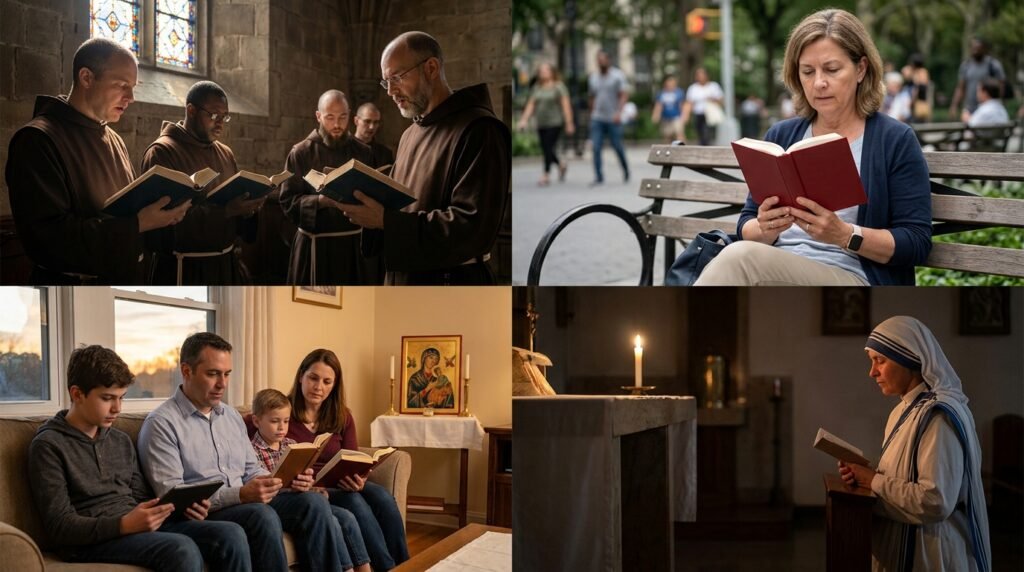
Traditionally, the Divine Office is organized into seven moments across the day, though the modern form used by most Catholics condenses some of the shorter daytime hours into a single Midday Prayer. The table below gives the full traditional structure.
| Hour | Traditional Time | Focus |
|---|---|---|
| Office of Readings | Any time, often before dawn | Extended Scripture and a reading from the saints or Church Fathers |
| Morning Prayer (Lauds) | At sunrise | Praise at the start of the day, centered on the Canticle of Zechariah |
| Midday Prayer | Mid-morning, noon, or mid-afternoon | A brief pause to reorient the workday toward God |
| Evening Prayer (Vespers) | At sunset | Thanksgiving for the day, centered on the Magnificat |
| Night Prayer (Compline) | Just before sleep | Examination of conscience and entrusting the night to God |
Each of these hours has its own character, but they all share the same basic shape: an opening verse, a hymn, psalms with their antiphons, a short Scripture reading, a responsory, a Gospel canticle or closing prayer, intercessions, the Lord's Prayer, and a concluding collect.
Where to Pray the Liturgy of the Hours Today
Praying the Divine Office no longer requires owning a four-volume set of breviaries, although many Catholics still prefer the printed page. If you are looking to pray the Liturgy of the Hours online, the USCCB Liturgy of the Hours page is the most widely used official English-language source in the United States, offering the full text for each hour of the current day, along with the correct psalms, readings, and prayers already selected according to the liturgical calendar.
Several free apps and websites also offer the Catholic daily Liturgy of the Hours in a mobile-friendly format, which is especially useful for Midday Prayer, since it is the hour most people pray away from home, at a desk, in a car during a lunch break, or between errands. Most of these platforms default to the Liturgy of the Hours in English, though many also provide the Liturgy of the Hours in Latin for those who wish to pray in the Church's traditional liturgical language, either alongside the English text or on its own.
| Where to Pray | Best For |
|---|---|
| A printed breviary (four-volume or one-volume Christian Prayer) | Those who want a distraction-free, lasting prayer book |
| The USCCB Liturgy of the Hours website | A free, official source for the correct text each day |
| A Liturgy of the Hours app | Praying Midday Prayer or Night Prayer away from home |
Wherever you choose to pray from, the words themselves matter less than the consistency of showing up to pray them. Many people who are new to this Christian prayer find it easier to begin with a single hour, most often Morning Prayer or Night Prayer, before gradually adding the others.
The Invitatory: How the Day of Prayer Begins
Before the first hour of the day, whether that is the Office of Readings or Morning Prayer, the Liturgy of the Hours opens with the Invitatory, a short psalm meant to summon the heart to prayer. This is almost always Psalm 95, prayed only once each day, at the very start, regardless of how many other hours follow.
Psalm 95, the Invitatory
Come, let us sing to the Lord and shout with joy to the Rock of our salvation. Let us come before Him giving thanks, and sing to Him with joyful songs. For the Lord is God, the mighty God, the great King over all the gods. In His hand are the depths of the earth, and the peaks of the mountains are His. The sea belongs to Him, for He made it, and His hands formed the dry land. Come, let us bow down and bend low, let us kneel before the God who made us, for He is our God and we are His people, the flock He shepherds. If today you hear His voice, harden not your hearts.
Morning Prayer: The Breviary's Lauds
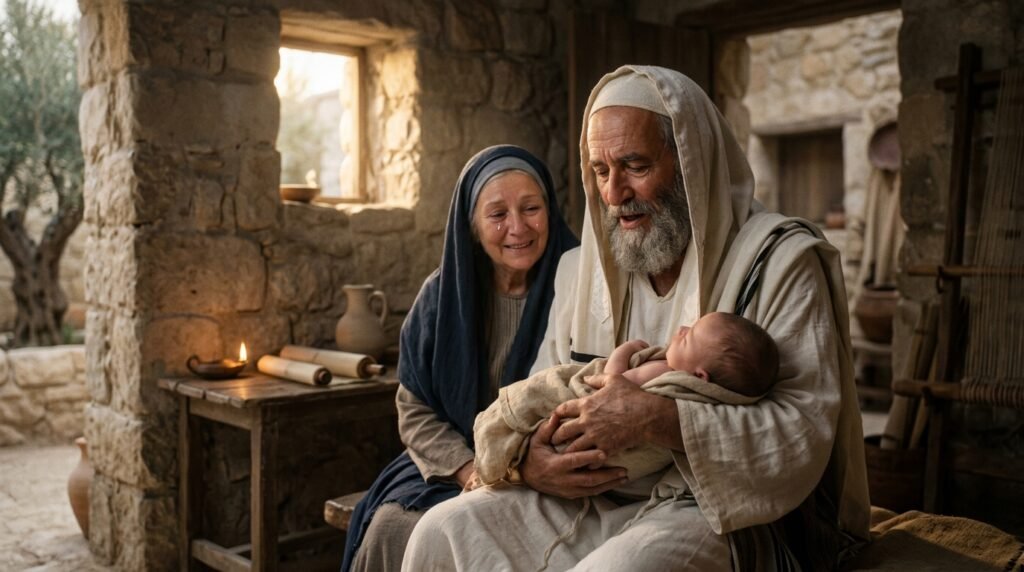
Morning Prayer, called Lauds in the breviary, is meant to be prayed as close to sunrise as your schedule allows, consecrating the first waking hours of the day to God before the day's demands take over. The breviary's Morning Prayer centers on the Canticle of Zechariah, the song of praise the elderly priest sang after the birth of his son, John the Baptist, when his voice was restored after months of silence.
Psalm 63, the Classic Morning Psalm
O God, You are my God, for You I long; for You my soul is thirsting. My body pines for You like a dry, weary land without water. So I gaze on You in the sanctuary to see Your strength and Your glory. For Your love is better than life, my lips will speak Your praise. So I will bless You all my life, in Your name I will lift up my hands. My soul shall be filled as with a banquet, my mouth shall praise You with joy. On my bed I remember You, on You I muse through the night, for You have been my help, in the shadow of Your wings I rejoice. My soul clings fast to You, Your right hand holds me firm.
The Canticle of Zechariah (Benedictus)
Blessed be the Lord, the God of Israel, for He has visited His people and worked their redemption. He has raised up for us a mighty Savior in the house of David His servant, as He promised through the mouth of His holy ones, the prophets of old. And you, my child, shall be called the prophet of the Most High, for you will go before the Lord to prepare His ways, to give His people knowledge of salvation through the forgiveness of their sins. In the tender compassion of our God, the dawn from on high shall break upon us, to shine on those who dwell in darkness and the shadow of death, and to guide our feet into the way of peace.
A simple Morning Prayer following the Liturgy of the Hours pattern moves through an opening versicle, a hymn, two psalms and an Old Testament canticle, a short reading, this Canticle of Zechariah, intercessions for the day ahead, the Lord's Prayer, and a closing collect.
A Closing Collect for Morning Prayer
Lord God, as this new day begins, let Your light rise upon us and guide everything we say and do. Keep us free from sin and safe from every danger, and lead us in the way of Your peace. Through Christ our Lord. Amen.
Midday Prayer: A Pause in the Middle of the Day
Midday Prayer is the shortest and most flexible hour, meant to be prayed at some point between Morning and Evening Prayer, whether at mid-morning, noon, or mid-afternoon, corresponding to what the older tradition called Terce, Sext, and None. Its purpose is simple: to interrupt the momentum of the workday with a brief return to God, even if only for two or three minutes.
| Element | Purpose |
|---|---|
| Opening versicle | Marks the shift from work back to prayer |
| A short psalm | Refocuses the mind on God partway through the day |
| A brief reading and closing prayer | Offers the remainder of the day back to God |
Psalm 121, the Classic Midday Psalm
I lift up my eyes to the mountains; from where shall come my help? My help shall come from the Lord, who made heaven and earth. May He never allow you to stumble; let Him sleep not, your guard. No, He sleeps not nor slumbers, Israel's guard. The Lord is your guard and your shade; at your right side He stands. By day the sun shall not smite you, nor the moon in the night. The Lord will guard you from evil, He will guard your soul. The Lord will guard your going and coming, both now and forever.
Lord, in the middle of this busy day, I stop to remember that You are here. Steady my mind, guard my words, and let everything I do this afternoon be done for Your glory rather than my own. Amen.

Evening Prayer: The Breviary's Vespers
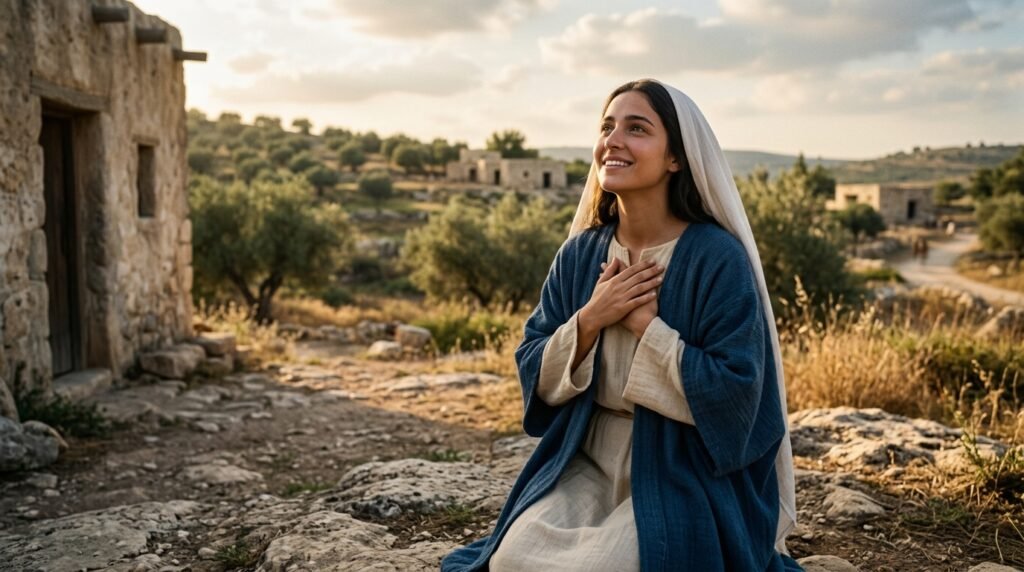
Evening Prayer, or Vespers, is prayed at sunset as the day's work comes to a close, and it centers on the Magnificat, the song of praise Mary sang when she visited her cousin Elizabeth, carrying Christ within her.
Psalm 141, the Classic Evening Psalm
O Lord, I call to You, come to me quickly; hear my voice when I cry to You. Let my prayer arise before You like incense, the raising of my hands like an evening oblation. Set a guard, O Lord, over my mouth, keep watch at the door of my lips. Do not let my heart incline to any evil, or busy itself with wicked deeds. Let the just correct me in mercy and reprove me, but let the oil of the wicked never anoint my head. My eyes are fixed on You, O God, my Lord; in You I take refuge, spare my soul.
The Canticle of Mary (Magnificat)
My soul proclaims the greatness of the Lord, my spirit rejoices in God my Savior, for He has looked with favor on His lowly servant. From this day all generations will call me blessed, for the Almighty has done great things for me, and holy is His name. He has mercy on those who fear Him in every generation. He has shown the strength of His arm; He has scattered the proud in their conceit. He has cast down the mighty from their thrones, and has lifted up the lowly. He has filled the hungry with good things, and the rich He has sent away empty. He has come to the help of His servant Israel, for He has remembered His promise of mercy, the promise He made to our fathers, to Abraham and his children forever.
Just as Morning Prayer opens the day with the Canticle of Zechariah, Evening Prayer closes it in the same spirit of thanksgiving, moving through psalms, a short reading, the Magnificat, intercessions, and a closing collect that hands the night over to God.
A Closing Collect for Evening Prayer
Lord, as the light of day fades, we thank You for every grace this day has held, and we ask Your forgiveness for every way we have failed to love You well. Watch over those we love, and grant peaceful rest to all who are weary tonight. Through Christ our Lord. Amen.
Night Prayer: The Breviary's Compline
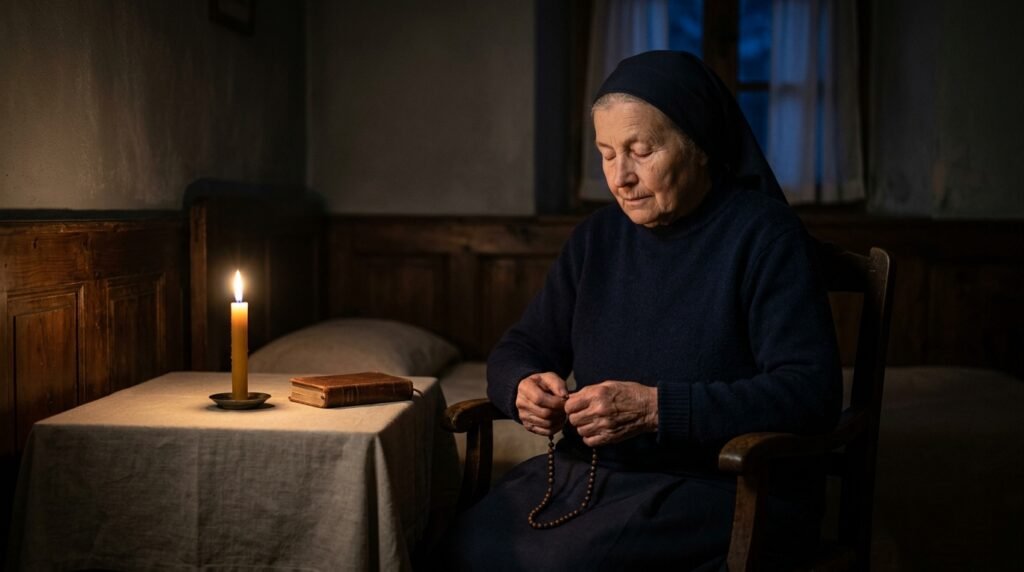
Night Prayer, known as Compline, is the last of the hours, prayed immediately before sleep, and it is often the simplest and most intimate part of the whole cycle. It includes a brief examination of conscience, a short psalm, and the Canticle of Simeon, the elderly man's prayer of peace upon finally holding the infant Christ in his arms.
A Brief Examination of Conscience
I confess to almighty God, and to you, my brothers and sisters, that I have sinned through my own fault, in my thoughts and in my words, in what I have done and in what I have failed to do. Therefore I ask the Blessed Virgin Mary, all the angels and saints, and you, my brothers and sisters, to pray for me to the Lord our God.
Psalm 91, the Classic Night Psalm
You who dwell in the shelter of the Most High, who abide in the shadow of the Almighty, say to the Lord: My refuge and my fortress, my God in whom I trust. He will free you from the snare of the fowler, and from the destroying plague. He will conceal you with His pinions, and under His wings you will find refuge. You will not fear the terror of the night, nor the arrow that flies by day. For He has given His angels charge over you, to guard you in all your ways. Upon their hands they will bear you up, lest you dash your foot against a stone.
The Canticle of Simeon (Nunc Dimittis)
Lord, now You let Your servant go in peace, Your word has been fulfilled. My own eyes have seen the salvation which You have prepared in the sight of every people, a light to reveal You to the nations and the glory of Your people Israel.
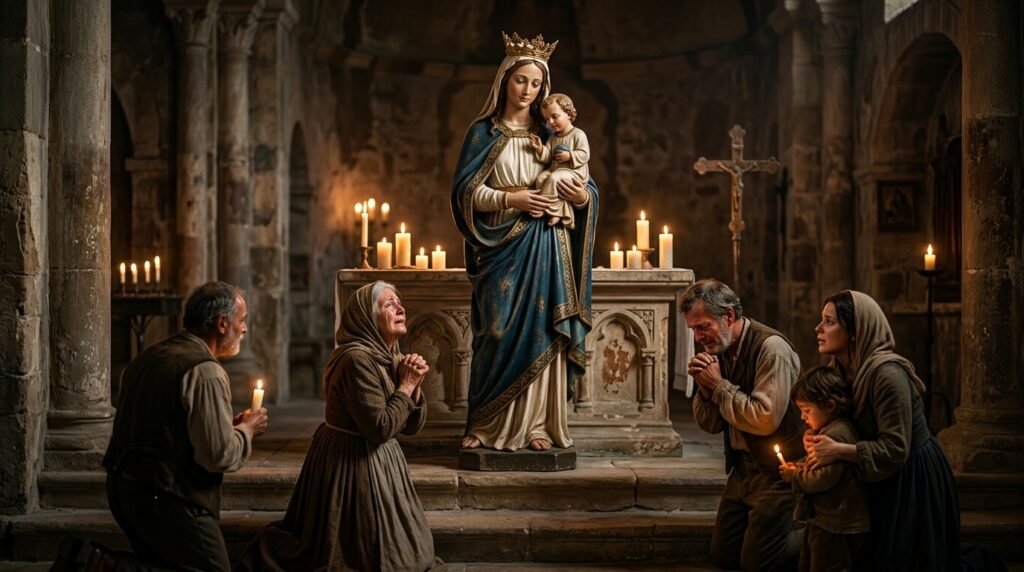
Night Prayer traditionally closes with one of the four ancient antiphons to the Blessed Virgin Mary, along with a very old prayer asking for God's protection through the hours of sleep, when we are at our most defenseless.
A Traditional Prayer for the Night
Visit this dwelling, O Lord, and drive far from it every snare of the enemy. Let Your holy angels dwell here to keep us in peace, and let Your blessing be upon us always. Through Christ our Lord. Amen.
Salve Regina, the Closing Marian Antiphon
Prayed during Ordinary Time. Three other antiphons rotate in through the year: the Alma Redemptoris Mater during Advent and Christmas, the Ave Regina Caelorum during Lent, and the Regina Caeli during Easter.
Hail, Holy Queen, Mother of Mercy, our life, our sweetness, and our hope. To thee do we cry, poor banished children of Eve. To thee do we send up our sighs, mourning and weeping in this valley of tears. Turn then, most gracious Advocate, thine eyes of mercy toward us, and after this our exile, show unto us the blessed fruit of thy womb, Jesus. O clement, O loving, O sweet Virgin Mary.
The Office of Readings: The Heart of the Divine Office
The Office of Readings is the longest and most contemplative hour of the Liturgy of the Hours, traditionally prayed before dawn, though it can be prayed at any point in the day if needed. Unlike the other hours, which are brief and built mainly around psalms, the Office of Readings includes two extended readings: a longer passage of Scripture, followed by a reading drawn from a Church Father, a saint, or another spiritual writer whose reflection illuminates that day's Scripture or feast.
| Part | What It Contains |
|---|---|
| Opening and hymn | A versicle and a hymn suited to the hour or the season |
| Three psalms | Longer than the psalmody of the other hours |
| First reading | An extended passage of Scripture, often following a continuous course through a biblical book |
| Second reading | A reflection from a saint, Church Father, or Church document, chosen to complement the day |
| Closing prayer | The same collect prayed at Morning Prayer that day |
This hour is where much of the Church's theological memory lives. Praying it daily means walking, over the course of a year, through long stretches of Scripture alongside centuries of Christian reflection on it, from Augustine and Gregory the Great to more recent saints and Church teaching.
First Psalm — an example; the three psalms actually prayed rotate through a four-week cycle.
Psalm 1
Blessed is the man that walketh not in the counsel of the ungodly, nor standeth in the way of sinners, nor sitteth in the seat of the scornful. But his delight is in the law of the Lord; and in his law doth he meditate day and night. And he shall be like a tree planted by the rivers of water, that bringeth forth his fruit in his season; his leaf also shall not wither; and whatsoever he doeth shall prosper. The ungodly are not so: but are like the chaff which the wind driveth away. For the Lord knoweth the way of the righteous: but the way of the ungodly shall perish.
Second Psalm — an example.
Psalm 8
O Lord our Lord, how excellent is thy name in all the earth! Who hast set thy glory above the heavens. When I consider thy heavens, the work of thy fingers, the moon and the stars, which thou hast ordained; what is man, that thou art mindful of him? And the son of man, that thou visitest him? For thou hast made him a little lower than the angels, and hast crowned him with glory and honour. Thou madest him to have dominion over the works of thy hands; thou hast put all things under his feet. O Lord our Lord, how excellent is thy name in all the earth!
Third Psalm — an example.
Psalm 19
The heavens declare the glory of God; and the firmament sheweth his handywork. Day unto day uttereth speech, and night unto night sheweth knowledge. There is no speech nor language, where their voice is not heard. The law of the Lord is perfect, converting the soul: the testimony of the Lord is sure, making wise the simple. The statutes of the Lord are right, rejoicing the heart: the commandment of the Lord is pure, enlightening the eyes. More to be desired are they than gold, yea, than much fine gold: sweeter also than honey and the honeycomb.
First Reading — an example; the actual passage changes daily according to the liturgical calendar.
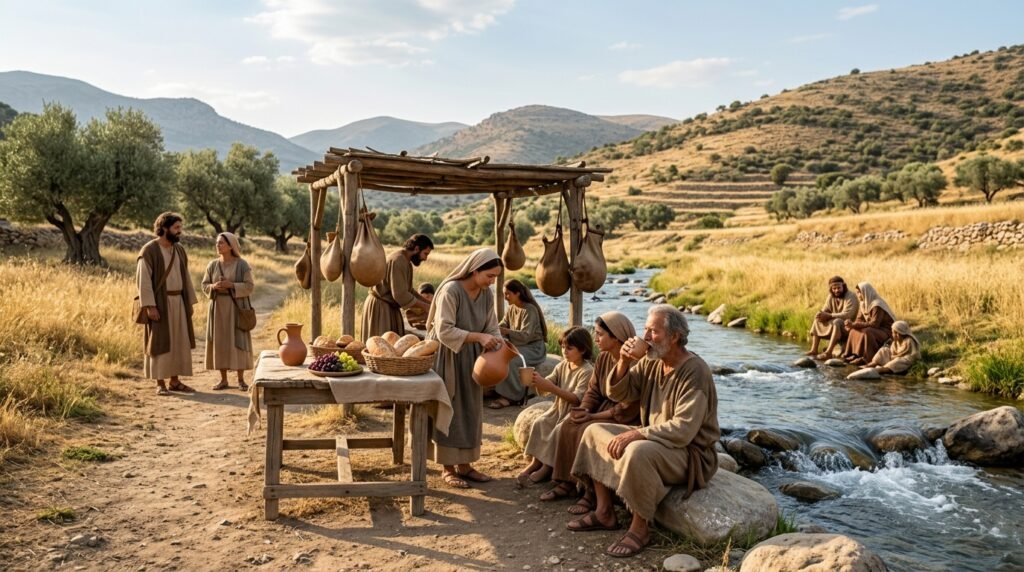
Isaiah 55:1-3
Ho, every one that thirsteth, come ye to the waters, and he that hath no money; come ye, buy, and eat; yea, come, buy wine and milk without money and without price. Wherefore do ye spend money for that which is not bread? And your labour for that which satisfieth not? Hearken diligently unto me, and eat ye that which is good, and let your soul delight itself in fatness. Incline your ear, and come unto me: hear, and your soul shall live; and I will make an everlasting covenant with you.
Responsory
Come to me, all who thirst, though you have no money.
Come, and drink with joy from the waters of salvation.
Second Reading — an example of the patristic readings used on this hour, from Saint Augustine's Confessions.
From the Confessions of Saint Augustine, Bishop
Too late have I loved Thee, O Beauty so ancient and so new, too late have I loved Thee! Behold, Thou wert within, and I abroad, and there I searched for Thee. Thou wast with me, but I was not with Thee. Thou calledst, and criedst aloud, and forcedst open my deafness. Thou didst gleam and shine, and chase away my blindness. Thou didst breathe fragrance upon me, and I drew in my breath, and now I pant for Thee. I tasted Thee, and now I hunger and thirst for Thee. Thou didst touch me, and I burned for Thy peace.
Responsory
I sought the Lord, and he answered me.
He delivered me from all my fears.
On Sundays and solemnities, the Office of Readings closes with this ancient hymn of praise before the final prayer.
Te Deum
We praise thee, O God: we acknowledge thee to be the Lord. All the earth doth worship thee, the Father everlasting. To thee all angels cry aloud, the heavens and all the powers therein. To thee cherubim and seraphim continually do cry: Holy, holy, holy, Lord God of Sabaoth. Heaven and earth are full of the majesty of thy glory.
A Closing Prayer for the Office of Readings
Lord God, open our minds to understand Your Scriptures and our hearts to be changed by them. Let the words we have read this day take root in us, and bear fruit in how we love and serve You. Through Christ our Lord. Amen.
Christian Prayer: The One-Volume Breviary for Everyday Use
Most laypeople who pray the Divine Office do not use the full four-volume Catholic breviary that priests and religious communities are bound to pray in its entirety. Instead, many use a single-volume edition, often published under the title Christian Prayer, which contains everything needed for Morning Prayer, Evening Prayer, and Night Prayer every day of the year, along with a selection from the Office of Readings for major feasts and Sundays. It leaves out the full daily cycle of the Office of Readings and some of the seasonal variations found in the complete edition, making it a practical starting point for anyone who wants to pray the Hours without carrying four separate volumes.
Praying the Liturgy of the Hours Today: Building a Daily Habit
Anyone who has tried to pick up the Liturgy of the Hours knows the real challenge is rarely understanding the structure; it is simply remembering to pray it consistently. A few practical habits make a significant difference for those learning to pray the Liturgy of the Hours today, in the middle of an ordinary, busy life.
- Start with one hour, not all five. Morning Prayer or Night Prayer are usually the easiest to build into an existing routine, since they attach naturally to waking up or going to bed.
- Let the current date do the work. The Liturgy of the Hours for today is already selected for you, whether you use a printed breviary with ribbons marking the day or an app that opens directly to the correct page, so there is no need to choose your own psalms or readings.
- Pray it at the same time each day. Consistency matters more than duration; five focused minutes at a fixed time will build a lasting habit faster than an occasional twenty-minute session.
- Do not worry about praying it perfectly. The structure can feel unfamiliar at first, with its antiphons, responsories, and shifting seasonal texts, but this is prayer meant to be grown into gradually, not mastered on the first attempt.
Recommended video
Frequently Asked Questions About the Liturgy of the Hours (FAQ)
Below, we answer common questions about praying the Divine Office, from its structure to where to find the correct prayers each day.
1. What is the difference between the Liturgy of the Hours and the Divine Office?
There is no difference; the Divine Office is simply the older name for what is now more commonly called the Liturgy of the Hours in English. Both terms refer to the same official daily prayer of the Church, prayed at fixed hours throughout the day.
2. Can laypeople pray the Liturgy of the Hours, or is it only for priests?
Laypeople are warmly encouraged to pray it. While priests and religious are obligated to pray the full prayers of the Divine Office each day, the Second Vatican Council specifically invited the laity to take up this same prayer, and many Catholics now pray at least Morning and Evening Prayer as part of their daily routine.
3. Where can I find the Liturgy of the Hours for today?
The USCCB Liturgy of the Hours website publishes the complete, correct text for each hour every day, already matched to the current liturgical calendar. Several free apps offer the same Liturgy of the Hours today, which is especially convenient for praying Midday Prayer away from home.
4. What book do I need to pray the Liturgy of the Hours?
The full Catholic breviary is published in four volumes, one for each liturgical season, and contains the complete Office of Readings for every day of the year. Most laypeople instead use a one-volume edition called Christian Prayer, which covers Morning, Evening, and Night Prayer daily and is far easier to carry and use.
5. What are the canonical hours in the Catholic Church?
The canonical hours are the fixed points of prayer throughout the day: the Office of Readings, Morning Prayer, Midday Prayer, Evening Prayer, and Night Prayer. Older tradition further divided Midday Prayer into three separate hours, Terce, Sext, and None, though the modern form usually combines them into one.
6. How long does it take to pray one hour of the Divine Office?
Morning Prayer and Evening Prayer typically take about ten to fifteen minutes, Night Prayer closer to five, and the Office of Readings can run twenty minutes or more due to its longer psalms and two extended readings. Midday Prayer is the shortest of all, often complete in under five minutes.
7. Is the Liturgy of the Hours available in Latin?
Yes. The Liturgy of the Hours in Latin, known as the *Liturgia Horarum*, is the Church's official version, and several publishers and apps offer it either on its own or alongside an English translation for those who wish to pray in both languages.
8. Do I have to pray all five hours every day?
No. While clergy and religious are bound to pray the full cycle, laypeople are free to pray as much or as little of the Liturgy of the Hours as fits their life. Many begin with just one hour, most often Morning or Night Prayer, and add others gradually as the habit takes hold.
9. What is the difference between the Liturgy of the Hours and the Rosary?
The Rosary is a devotional prayer centered on meditating on the life of Christ through the eyes of Mary, while the Liturgy of the Hours is the Church's official liturgical prayer, built primarily around the Book of Psalms and Scripture. Both are valuable forms of Christian prayer, but they serve different purposes and follow entirely different structures.
10. Can I pray the Liturgy of the Hours alone, or does it require a group?
It can be prayed either way. The Liturgy of the Hours was originally designed for communal recitation, and many parishes and religious communities still pray it together, but it is entirely valid and complete when prayed alone, whether from a printed breviary or the Liturgy of the Hours online.
Si quieres conocer otros artículos parecidos a Liturgy of the Hours: A Complete Guide to the Divine Office & Catholic Breviary puedes visitar la categoría Prayers.