
Saint Joseph the Worker: His Life, Feast Day, Medal, Novena, Complete Prayers

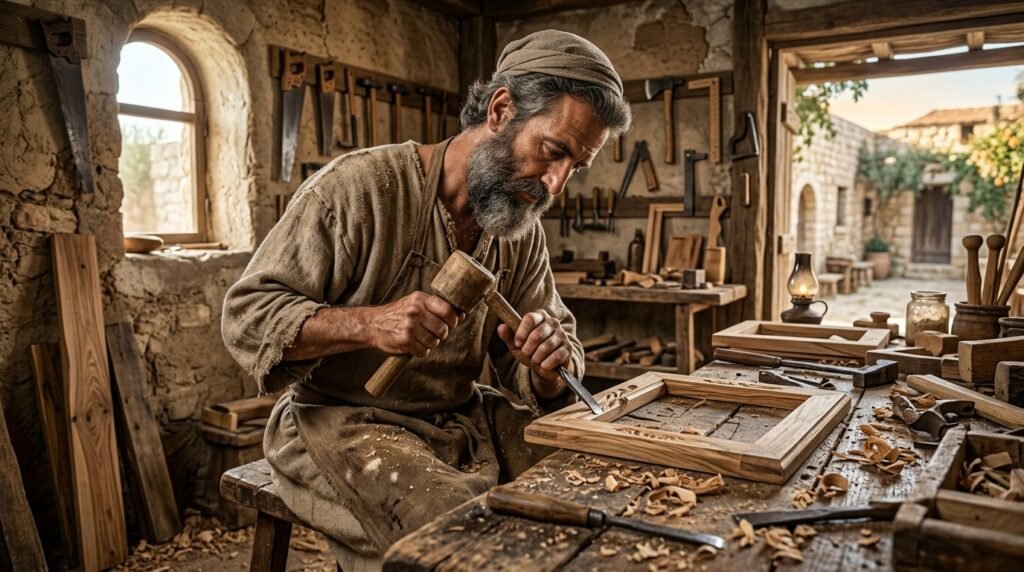
Every May 1, while much of the world marks International Workers' Day with parades and political rallies, the Catholic Church quietly offers its own answer to the same question, what does honest work actually mean? The response comes not through a manifesto but through a carpenter from Nazareth, a man who spent most of his life shaping wood with his hands, raising a child who was not biologically his own, and never once appearing in Scripture to speak a single recorded word. Saint Joseph the Worker has become, for millions of Catholics, the patron who understands labor from the inside, not as an abstract virtue but as something lived daily, tiredly, and faithfully.
This guide brings together everything worth knowing about this feast: the life of Joseph as a working man in first-century Nazareth, the fascinating and deliberate history of how his May 1 feast day came to exist, complete prayers for laborers, carpenters, and those searching for work, a nine-day novena, information about the Saint Joseph the Worker medal, and a look at the Sisters of Saint Joseph the Worker, a real religious community still active today. Every prayer here is written out in full.
In Short
Saint Joseph the Worker, celebrated on May 1, was instituted as a feast by Pope Pius XII in 1955 to affirm the dignity of labor in response to communist May Day celebrations, honoring Joseph, the carpenter of Nazareth, as the patron saint of workers, carpenters, and laborers everywhere.
-
Worker or Laborer? A Quick Note on the Name
- The Life of Saint Joseph the Worker
- The Feast Day of Saint Joseph the Worker: Origin and History
- Saint Joseph: Patron Saint of Workers and Carpenters
- Prayers for Saint Joseph the Worker
- A Prayer to Saint Joseph the Worker for Employment
- A Short Daily Prayer to Saint Joseph the Worker
- The Story of Saint Joseph the Worker: Life in Nazareth
- The Saint Joseph the Worker Medal
- The Sisters of Saint Joseph the Worker
- A Nine-Day Novena to Saint Joseph the Worker
- Recommended video
- Frequently Asked Questions About Saint Joseph the Worker (FAQ)
Worker or Laborer? A Quick Note on the Name
Some older prayer books, missals, and English translations refer to this same feast as Saint Joseph the Laborer rather than Saint Joseph the Worker. Both titles refer to the identical May 1 feast and the identical historical figure; the difference is simply a matter of translation preference, since "laborer" and "worker" both render the same underlying Latin title used in the Church's official liturgical texts.
Worker or Laborer? Both titles are correct and refer to the same feast. English-speaking countries generally settled on "Worker" in modern usage, while "Laborer" appears more often in older missals and certain regional translations.
The Life of Saint Joseph the Worker
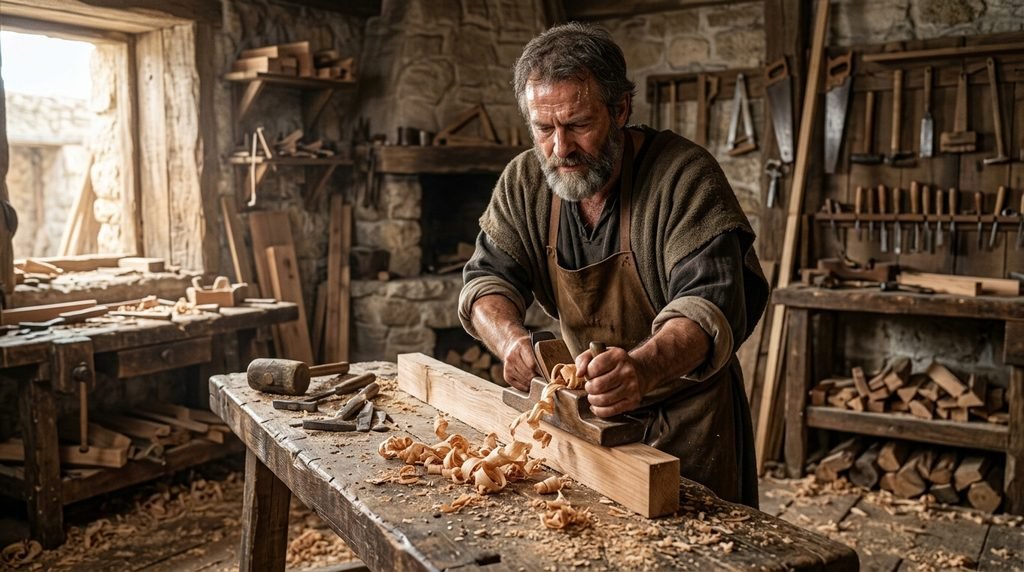
The Gospels tell us remarkably little about Joseph directly, no words of his are recorded anywhere in Scripture, yet what little we know places work at the very center of his identity. Matthew's Gospel identifies him plainly as a tekton, a Greek word usually translated as carpenter, though it more broadly describes a craftsman who worked with wood, stone, or both, building furniture, tools, and structures for his community in Nazareth. This was not a glamorous trade; it was steady, physically demanding labor that provided for a family without fanfare or recognition.
Betrothed to Mary and entrusted, according to Catholic tradition, with the extraordinary responsibility of raising Jesus as his own son, Joseph appears throughout the infancy narratives as a man who acted decisively and quietly: he took Mary as his wife despite the scandal of her pregnancy, he led the Holy Family to safety in Egypt to escape Herod's violence, and he brought them home again once the danger had passed. Jesus Himself is later called "the carpenter's son" in the Gospel of Matthew, and in Mark's Gospel, the townspeople of Nazareth refer to Jesus as "the carpenter" outright, a strong indication that He learned and practiced His foster father's trade before beginning His public ministry. For roughly three decades, then, the Son of God's daily life consisted largely of ordinary manual labor, learned at Joseph's side.
The Feast Day of Saint Joseph the Worker: Origin and History
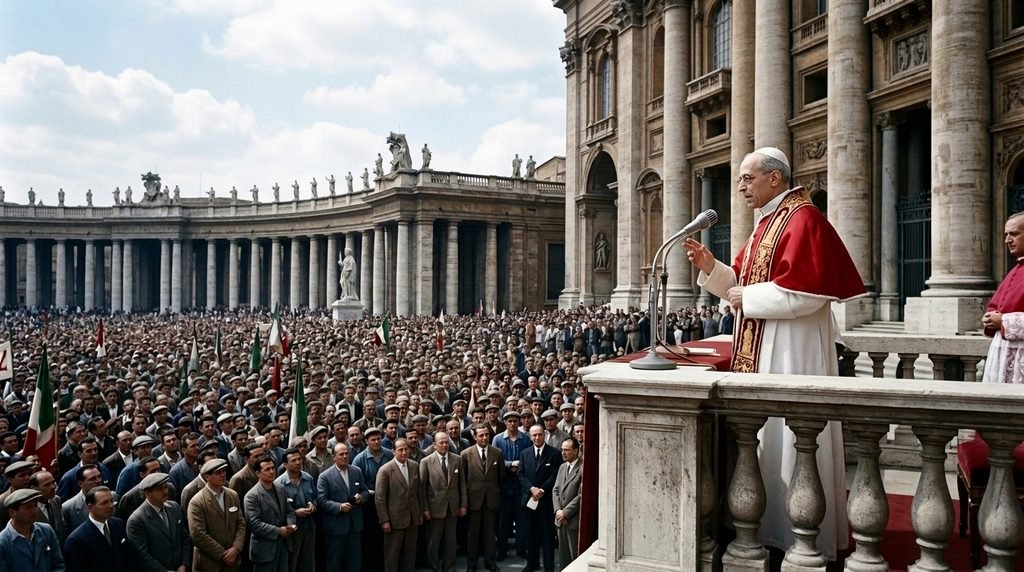
Unlike many feasts that developed gradually over centuries, the feast of Saint Joseph the Worker has a precise, documented birthday: May 1, 1955. On that date, Pope Pius XII addressed the Catholic Association of Italian Workers in Saint Peter's Square and formally instituted this new feast, deliberately choosing May 1 because it coincided with International Workers' Day, the secular labor holiday that communist governments across the world used to celebrate their own vision of the working class, often accompanied by large military parades and displays of Soviet strength.
Pius XII's intention was not simply symbolic opposition. He wanted Catholic workers to have their own genuinely Christian understanding of labor's dignity, rooted not in class struggle but in the example of a man who sanctified ordinary work through quiet faithfulness. In his address that day, the Pope said directly: "There could not be a better protector to help you penetrate the spirit of the Gospel into your life... it is certain that no worker has ever been as perfectly and deeply penetrated by it as the putative Father of Jesus, who lived with Him in the closest intimacy and commonality of family and work." He closed with the same phrase Pope Leo XIII had used decades earlier in his own writing on Joseph: "Ite ad Ioseph," go to Joseph.
| Detail | Fact |
|---|---|
| Feast Instituted | May 1, 1955, by Pope Pius XII |
| Occasion | Address to the Catholic Association of Italian Workers |
| Reason for the Date | Deliberately chosen to coincide with communist International Workers' Day |
| Other Feast Day | March 19, Solemnity of Saint Joseph, Husband of Mary, dating to the tenth century |
It is worth noting that Joseph shares this distinction, having two separate feast days on the Church's universal calendar, with only Saint John the Baptist and the Virgin Mary herself, a small but telling sign of how central he has remained to Catholic devotion across the centuries.
Saint Joseph: Patron Saint of Workers and Carpenters
| Patronage | Context |
|---|---|
| Workers and Laborers | Formalized through the 1955 feast, honoring the dignity of ordinary daily labor |
| Carpenters | His own documented trade in the Gospels |
| The Universal Church | Declared by Pope Pius IX in 1870 |
| Fathers and Families | Reflecting his role as foster father of Jesus and protector of the Holy Family |
For Workers and Laborers
Saint Joseph, you understood the weariness and the dignity of a long day's labor. Watch over every worker today, in fields, factories, offices, and homes, and let them find in their work a real sense of purpose rather than only exhaustion. Amen.
For Carpenters and Craftsmen
Saint Joseph, patron of your own trade, watch over carpenters, builders, and craftsmen everywhere. Guide their hands to careful, honest work, protect them from harm at their tools, and let what they build serve others well and last. Amen.
For the Universal Church
Saint Joseph, patron and protector of the whole Church, watch over her today as faithfully as you once watched over the Holy Family. Guard her from harm, strengthen her in trial, and guide her always toward Christ. Amen.
For Fathers and Families
Saint Joseph, foster father of Jesus and quiet protector of Mary, watch over every father today, especially those who feel unsure whether they are doing enough. Give them your same patience, your same steadiness, and your same quiet love. Amen.
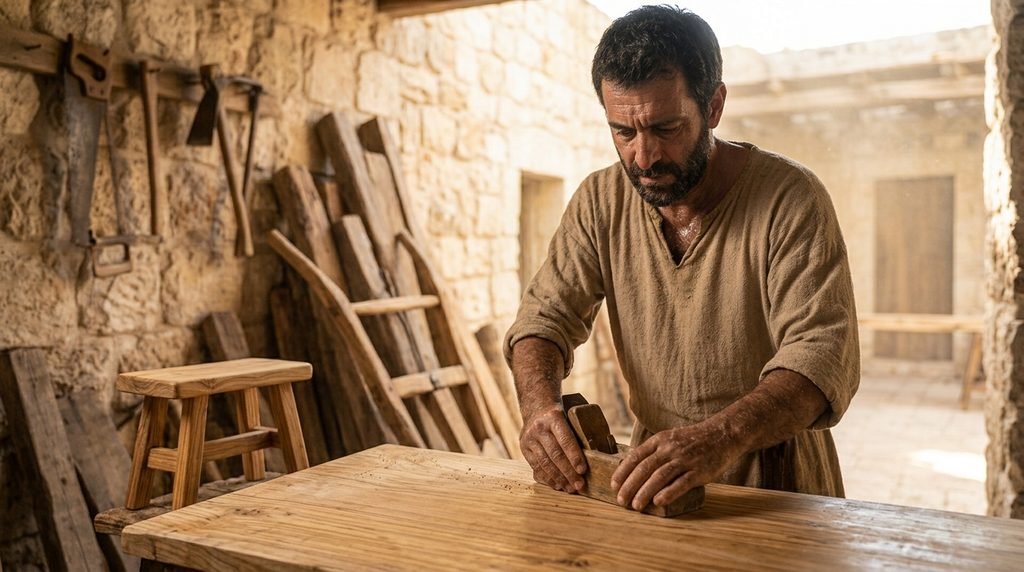
Prayers for Saint Joseph the Worker
This is the most widely used prayer associated with this devotion, honoring both Joseph's example and his continued intercession for those who labor.
O Glorious Saint Joseph, model of all who are devoted to labor, obtain for me the grace to work in a spirit of penance, in order to atone for my many sins. To work conscientiously, putting the call of duty above my own inclinations. To work with gratitude and joy, considering it an honor to employ and to develop, by my labor, the gifts I have received from God. To work with order, peace, moderation, and patience, without ever shrinking from it through weariness or difficulty. To work above all with a pure intention and with detachment from self, having always before my eyes the hour of death and the accounting which I must render of time lost, of talents wasted, of good omitted, and of vain complacency in success, so fatal to the work of God. All for Jesus, all through Mary, all in imitation of you, O Patriarch Joseph. This shall be my motto in life and in death. Amen.
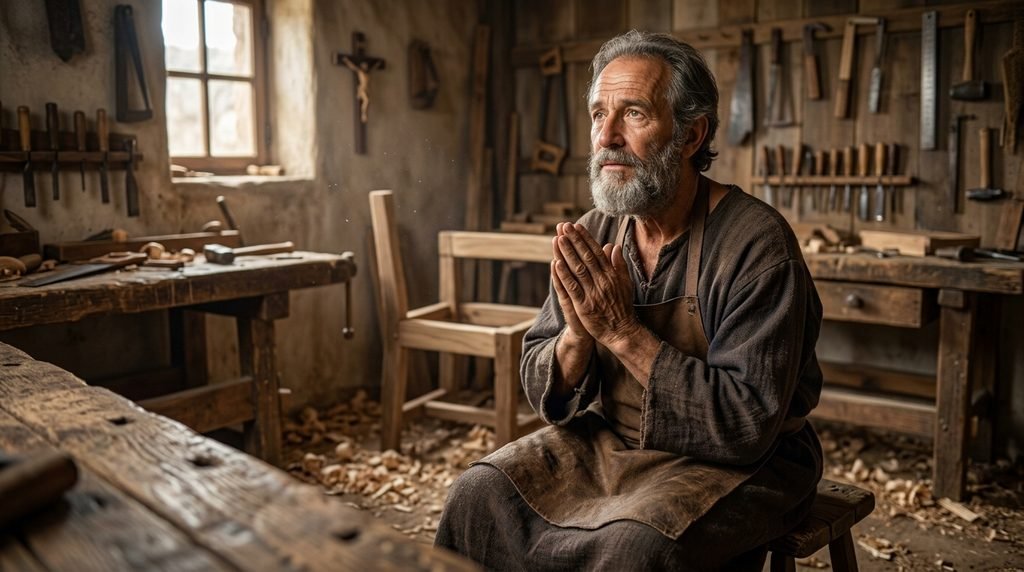
A Prayer to Saint Joseph the Worker for Employment
Many people specifically turn to Joseph when searching for work, drawing on his reputation as one who provided steadily and faithfully for his family.
Saint Joseph, you knew what it meant to provide for a family through the steady, sometimes uncertain work of your own two hands. I bring before you today my need for honest, stable employment, whether I am searching for the first time or hoping to find something better than what I currently have. Guide me toward work that provides for my needs and allows me to use the gifts God has given me. Give me patience through the search, and confidence that You understand this particular kind of worry better than almost anyone. Amen.

A Short Daily Prayer to Saint Joseph the Worker
Saint Joseph the Worker, teach me to find holiness in the ordinary work of this day. Amen.
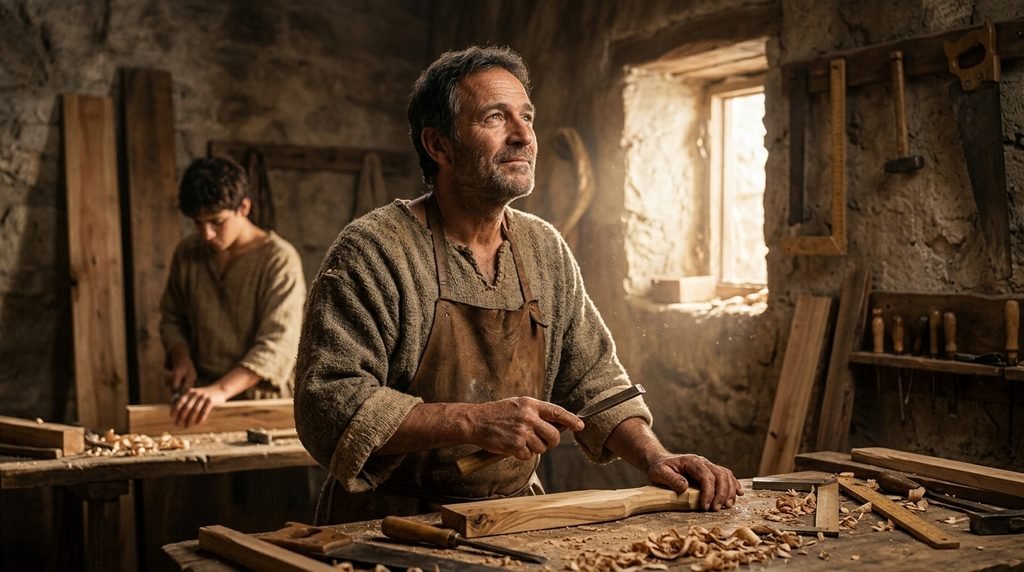
The Story of Saint Joseph the Worker: Life in Nazareth
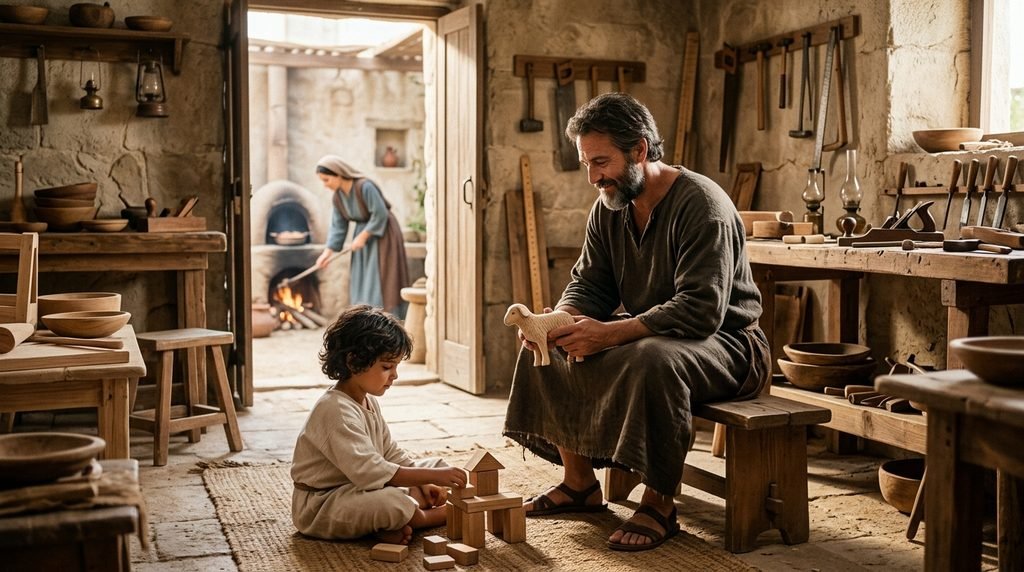
The workshop where Joseph labored would have been a simple space, likely attached to or near the family's home in Nazareth, a small, unremarkable village of perhaps a few hundred people in Galilee. There, using tools that archaeological evidence from the period suggests included adzes, saws, awls, and drills, Joseph would have built and repaired the practical items his neighbors needed, doors, yokes for oxen, farming implements, furniture, and roof beams, since large-scale stonework for buildings often overlapped with a tekton's trade as well.
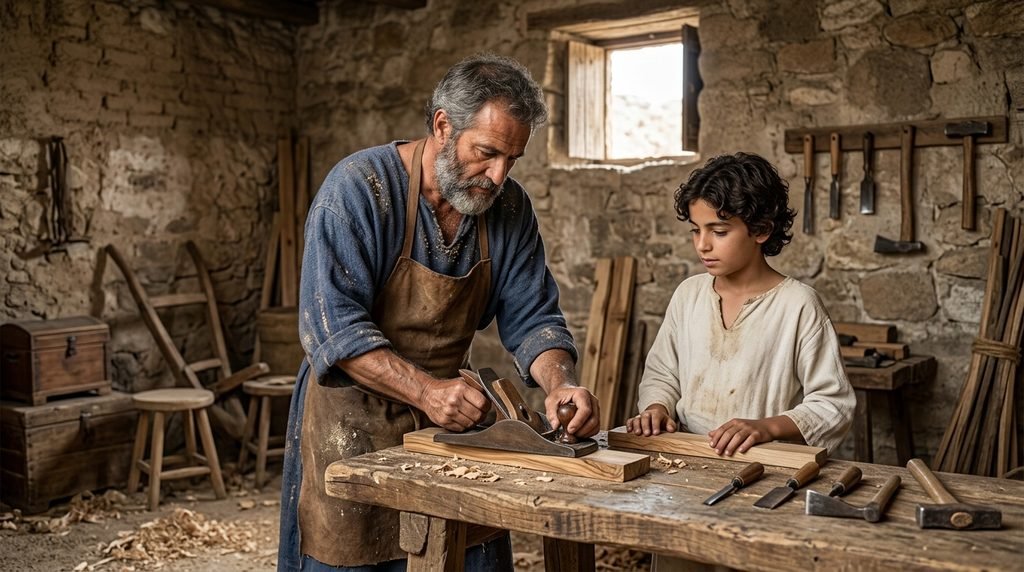
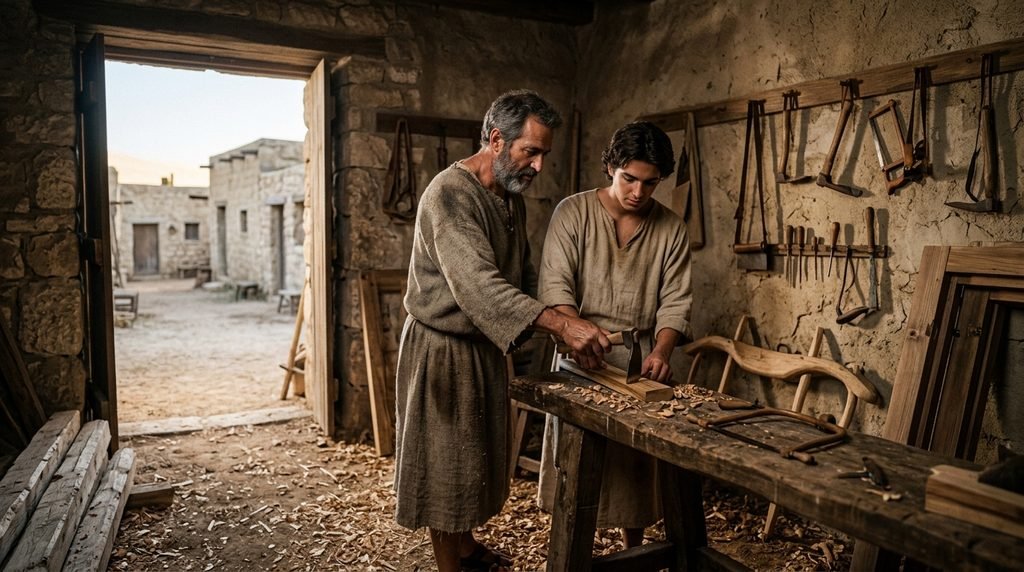
It was in this same workshop, according to long-standing Christian tradition, that Jesus grew from childhood into manhood, standing beside Joseph and gradually learning the same skills, the patience of careful measurement, the discipline of honest craftsmanship, and the quiet satisfaction of a task completed well. Luke's Gospel offers only a brief summary of these hidden years, noting simply that Jesus "increased in wisdom and in stature, and in favor with God and man," years spent almost entirely within the rhythm of ordinary work rather than public ministry. This extended, largely undocumented period of Christ's life has long given Catholic spirituality a rich source of reflection: that the vast majority of Jesus's earthly life was spent not preaching or performing miracles, but simply working, and that this labor itself carried real spiritual meaning.
The Saint Joseph the Worker Medal
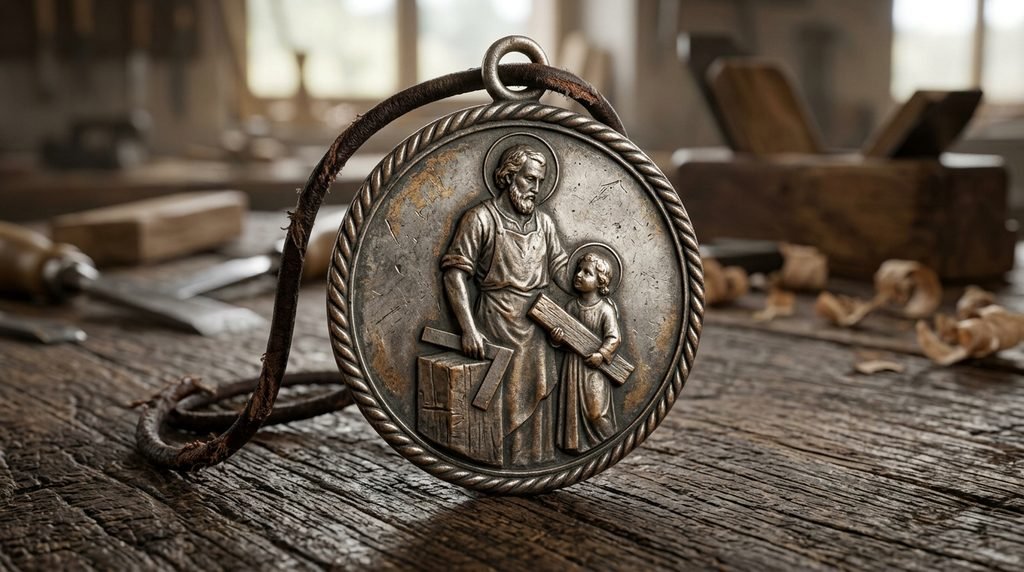
Devotional medals depicting Saint Joseph the Worker typically show him holding tools of his trade, most often a carpenter's square or a saw, sometimes alongside the young Jesus, and are commonly worn or carried by tradespeople, laborers, and job seekers as a visible reminder of his intercession. Many Catholics also place such a medal, or a small statue of Joseph, in a new home, workshop, or place of business as an act of dedication and protection, asking that the work carried out there be blessed and fruitful.
The Sisters of Saint Joseph the Worker
Beyond the feast day and its devotions, Joseph's identity as a worker has also inspired the founding of religious communities dedicated specifically to his example. The Sisters of Saint Joseph the Worker, based in Walton, Kentucky, are one such congregation, a community of women religious who combine a contemplative and active life centered on the Holy Eucharist, devotion to Mary, and devotion to Saint Joseph, while dedicating themselves to Catholic education, the care of the elderly, and other forms of humble, practical service. Their charism reflects Joseph's own life directly: prayer joined seamlessly to ordinary, faithful labor, carried out without seeking recognition.

A Nine-Day Novena to Saint Joseph the Worker
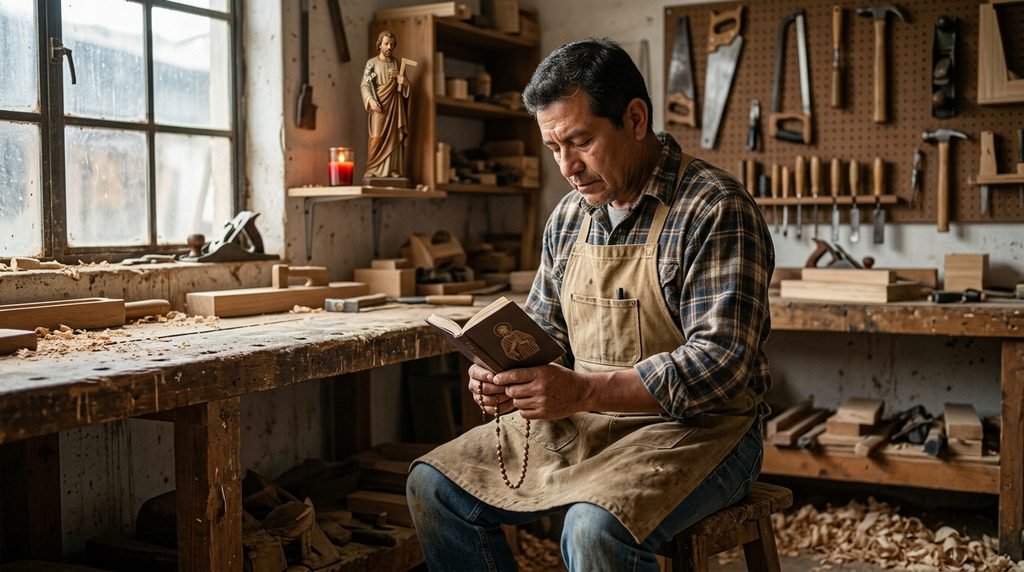
This novena draws on different aspects of Joseph's life as a working man, often prayed in the days leading up to his May 1 feast, or begun whenever someone faces a particular need related to work, employment, or their daily labor.
| Day | Theme | Intention |
|---|---|---|
| Day 1 | The Carpenter of Nazareth | For gratitude in the ordinary work of our daily lives. |
| Day 2 | Provider for the Holy Family | For those searching for stable work to provide for their families. |
| Day 3 | Teacher of the Trade | For patience and skill in learning something new. |
| Day 4 | Quiet Faithfulness | For strength to keep working faithfully even without recognition. |
| Day 5 | Protector Through Uncertainty | For those facing job loss or uncertain employment. |
| Day 6 | A Just and Fair Workplace | For fairness and dignity in our own workplace and industry. |
| Day 7 | Balance Between Work and Family | For the wisdom to balance our labor with our family and prayer life. |
| Day 8 | Patron of the Universal Church | For the Church, and for all who labor in her service. |
| Day 9 | Thanksgiving and Trust | In thanksgiving, entrusting our work and our future to God. |
Day 1 · The Carpenter of Nazareth
Saint Joseph, you spent most of your life at a workbench, shaping wood into what your neighbors needed, without ever seeking praise for it. Help me see my own daily work, however ordinary it feels, as something worth doing well and offering to God. Amen.
Day 2 · Provider for the Holy Family
Saint Joseph, you provided steadily for Mary and Jesus through your own labor, often without certainty about tomorrow. I ask you today for anyone searching for stable work to support their family, that they may find it soon and find it dignified. Amen.
Day 3 · Teacher of the Trade
Saint Joseph, you patiently taught your trade to Jesus, letting Him learn at your side one careful step at a time. Give me that same patience as I learn something new today, whether a skill, a job, or simply a new way of doing things. Amen.
Day 4 · Quiet Faithfulness
Saint Joseph, no words of yours are recorded in Scripture, and yet your quiet faithfulness shaped the Holy Family more than words ever could. Help me find the same value in the unseen, unrecognized parts of my own work today. Amen.
Day 5 · Protector Through Uncertainty
Saint Joseph, you led your family safely through the uncertainty of exile in Egypt, trusting God even when the path ahead was unclear. I bring before you today anyone facing job loss or an uncertain future at work, that they may find both provision and peace. Amen.
Day 6 · A Just and Fair Workplace
Saint Joseph, patron of workers, watch over the fairness and dignity of workplaces everywhere, including my own. Where labor is exploited or undervalued, intercede for justice, and help me treat everyone I work with the same dignity you gave to your own trade. Amen.
Day 7 · Balance Between Work and Family
Saint Joseph, your work never came before your family; it existed to serve them. Help me find that same balance, working hard without letting my labor crowd out the people and the prayer that matter most. Amen.
Day 8 · Patron of the Universal Church
Saint Joseph, patron of the whole Church, watch over all who labor in her service, priests, religious, and lay workers alike, often in ways just as hidden and unrecognized as your own carpentry once was. Amen.
Day 9 · Thanksgiving and Trust
Saint Joseph, as this novena closes, I thank you for walking with me through these nine days of prayer. I place my work, my search for employment, and my whole future into your hands, trusting that you understand better than most what it means to labor faithfully for those we love. Amen.
Recommended video
Frequently Asked Questions About Saint Joseph the Worker (FAQ)
Below, we answer common questions about his life, his feast day, and the devotion associated with him.
1. When is the feast day of Saint Joseph the Worker?
His feast is celebrated on May 1, instituted by Pope Pius XII in 1955. This is separate from the Solemnity of Saint Joseph, Husband of Mary, celebrated each year on March 19.
2. Why did Pope Pius XII choose May 1 for this feast?
Pius XII deliberately chose May 1 because it coincided with International Workers' Day, the secular labor holiday celebrated by communist governments, offering Catholic workers a genuinely Christian understanding of the dignity of labor as an alternative.
3. What was Saint Joseph's trade?
The Gospel of Matthew identifies Joseph as a tekton, usually translated as carpenter, though the Greek term more broadly describes a craftsman working with wood or stone. Jesus is later called both "the carpenter's son" and simply "the carpenter" in the Gospels, suggesting He learned the same trade.
4. What is Saint Joseph the patron saint of?
Beyond workers and carpenters, Saint Joseph was declared patron of the Universal Church by Pope Pius IX in 1870, and is also widely invoked as patron of fathers, families, and a happy death.
5. Why doesn't Joseph speak in the Gospels?
No words of Joseph are directly recorded anywhere in Scripture, though his actions, taking Mary as his wife, fleeing to Egypt, returning to Nazareth, speak clearly of quiet obedience and faithfulness. This silence has long been seen as a model of humble, unshowy devotion.
6. What does the Saint Joseph the Worker medal look like?
These medals typically depict Joseph holding tools of his trade, most often a carpenter's square or saw, sometimes alongside the young Jesus, and are commonly worn by tradespeople and job seekers as a reminder of his intercession.
7. Who are the Sisters of Saint Joseph the Worker?
The Sisters of Saint Joseph the Worker are a religious congregation based in Walton, Kentucky, dedicated to Catholic education, care of the elderly, and other forms of humble service, combining a contemplative and active life centered on devotion to the Eucharist, Mary, and Saint Joseph.
8. Can I pray to Saint Joseph the Worker if I'm searching for a job?
Yes, this is one of the most common reasons people turn to him. Because he provided steadily for the Holy Family through his own labor, many Catholics ask his intercession specifically when searching for stable, dignified employment.
9. Is Saint Joseph the Worker a different saint from Saint Joseph?
No. Saint Joseph the Worker
Si quieres conocer otros artículos parecidos a Saint Joseph the Worker: His Life, Feast Day, Medal, Novena, Complete Prayers puedes visitar la categoría Saints.