
Prayer of Archangel Uriel: Meaning, Origins & Invocations for protection, wisdom & exams


Of all the angelic names that circulate outside the three recognized by the Catholic Church, Uriel carries perhaps the deepest historical roots and the most direct history with the Church itself. His name, generally understood to mean "God is my light" or "Fire of God," has made him a figure closely tied to illumination, wisdom, and prophetic warning for nearly two thousand years. Yet his story includes something the others in this series do not: an explicit, documented rejection by name from an early Church council.
This guide traces where Uriel actually comes from, what the ancient texts that describe him say, why the Catholic Church does not include him among its recognized archangels, and what a prayer of Archangel Uriel looks like in the various contemporary invocations people use today for protection, study, love, and financial stability. As with the other figures in this series, everything here is presented with historical honesty, distinguishing carefully between ancient tradition, Church teaching, and modern devotional composition.
In Short
Uriel, whose name means "God is my light," is one of the most historically prominent angels named outside canonical Scripture, appearing in the Book of Enoch and 2 Esdras. He is not recognized as an archangel by the Catholic Church, which formally rejected his name in the eighth century and names only Michael, Gabriel, and Raphael.
-
Who Is Archangel Uriel? Origins in Ancient Jewish Literature
- Uriel and the Catholic Church: A Documented Rejection
- What Uriel Represents Across Tradition
- An Archangel Uriel Prayer for Protection
- Archangel Uriel Prayer for Exams and Studying
- Archangel Uriel Prayer for Love
- Archangel Uriel Prayer for Money and Financial Stability
- A General Invocation to Uriel
- How People Use These Invocations Today
- Uriel Compared to the Three Recognized Archangels
- Recommended video
- Frequently Asked Questions About the Prayer of Archangel Uriel (FAQ)
Who Is Archangel Uriel? Origins in Ancient Jewish Literature
Unlike Jophiel or Chamuel, whose names emerge mostly from medieval folk tradition and modern esotericism, Uriel appears in genuinely ancient texts, though ones that fall outside the biblical canon accepted by both Jews and Christians. His earliest and most detailed appearances are in the Book of Enoch, a Jewish apocalyptic text likely composed in stages between the third century BC and the first century AD, and in 2 Esdras, also called 4 Ezra, a Jewish text from around the first century AD that survives today mainly within certain biblical apocrypha.
In the Book of Enoch, Uriel is described as one of the principal angels, given authority over the world and, in some passages, specifically over the realm of punishment reserved for fallen angels. He serves as Enoch's guide through visionary journeys across the heavens, explaining the movements of the sun, moon, and stars, and is closely associated with hidden knowledge and cosmic order. In 2 Esdras, Uriel appears again as the angel sent to answer the prophet Ezra's anguished questions about suffering and divine justice, patiently walking him through difficult theological reasoning across several extended dialogues.
His name in Hebrew is generally understood to combine "or" or "ur," meaning light or fire, with "El," meaning God, giving the widely accepted translation "God is my light" or "Fire of God." This meaning runs consistently through nearly every tradition that describes him, illumination, revealed wisdom, and warning delivered with clarity.
| Source | Role Described |
|---|---|
| Book of Enoch | Guide of Enoch through the heavens; overseer of cosmic order and judgment |
| 2 Esdras (4 Ezra) | Angel sent to answer Ezra's questions about suffering and divine justice |

Uriel and the Catholic Church: A Documented Rejection
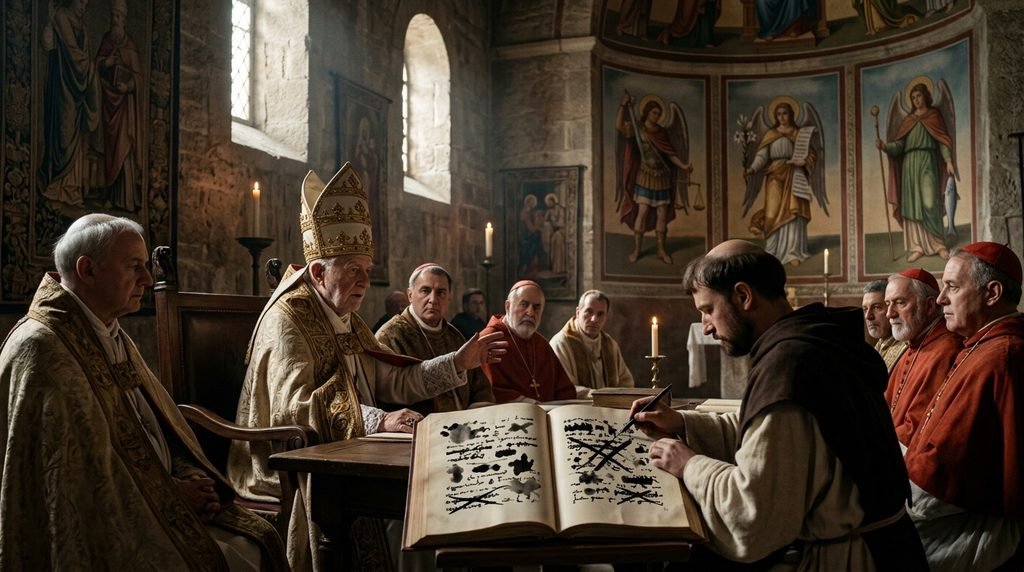
Here Uriel's history diverges sharply from figures like Jophiel or Chamuel, whose absence from Church teaching is simply a matter of never having been included. Uriel's case is more direct: his name was specifically addressed, and explicitly rejected, by an early Church council.
In the year 745, the Council of Rome, convened under Pope Zachary, condemned the practice of invoking angels by names not found in the canonical Scriptures, naming Uriel specifically among those to be excluded from Christian devotion, alongside several other angelic names in popular circulation at the time. This decision reflected a broader concern within the early Church: that devotion to angels drawn from apocryphal texts like the Book of Enoch, however ancient and theologically interesting those texts might be, risked drawing the faithful into speculative practices detached from the Church's own teaching authority.
It is worth being precise about what this means today. The Catholic Church recognizes only Michael, Gabriel, and Raphael as archangels, the three named directly in the canonical books of Scripture, each with a shared feast day on September 29 and centuries of approved liturgical prayer. Uriel, despite his genuine antiquity and his significant role within Jewish apocalyptic literature, does not hold that status, and a Catholic prayer to Archangel Uriel, in the sense of an officially approved Church devotion, does not exist.
This history does not erase the real theological and literary significance of the Book of Enoch and 2 Esdras, which remain important for understanding the development of Jewish and early Christian thought. It simply means that presenting devotion to Uriel as equivalent to the Church's approved prayers to Michael, Gabriel, and Raphael would misrepresent the Church's actual teaching, which addressed his name specifically, not merely by omission.
What Uriel Represents Across Tradition
Despite his exclusion from Catholic teaching, Uriel remained a figure of interest in various strands of later Jewish mysticism, Eastern Orthodox popular devotion in some regions, and, more recently, contemporary spiritual movements. Several consistent themes run through nearly every source that describes him.
| Theme | What Tradition Says |
|---|---|
| Illumination and Wisdom | Associated with revealed knowledge and clarity of understanding |
| Prophecy and Warning | Delivers difficult truths clearly, without softening them |
| Order and Judgment | Overseer of cosmic order in Enoch's visions |
| Repentance and Transformation | Later tradition links him to conversion and inner change |
An Archangel Uriel Prayer for Protection
Because no Church-approved prayer to Uriel exists, the invocation below is offered as a contemporary devotional composition, written in the spirit of the themes historically associated with him, rather than as liturgical or officially sanctioned text.
A contemporary devotional invocation, not an ancient liturgical text or a Church-approved prayer.
Uriel, whose name speaks of God's own light, stand between me and whatever confusion or danger this day may bring. Where darkness would mislead me, let light guide my steps instead. Where fear would paralyze me, let clarity give me the courage to act rightly. I ask this trusting in the mercy of God above every intermediary. Amen.

Archangel Uriel Prayer for Exams and Studying
Given his long association with revealed wisdom and clarity of mind, this invocation is commonly adapted by those preparing for exams or facing demanding study.
A contemporary devotional invocation, not an ancient liturgical text or a Church-approved prayer.
Uriel, associated in tradition with illumination and understanding, quiet my anxious mind as I prepare for what lies ahead. Help what I have studied come back to me clearly when I need it, and help me think with patience rather than panic under pressure. Let this test measure what I have learned, not the fear I carry into the room. Amen.

Archangel Uriel Prayer for Love
Some also adapt this invocation when seeking honesty and clarity in matters of the heart, drawing on Uriel's association with truth delivered plainly.
A contemporary devotional invocation, not an ancient liturgical text or a Church-approved prayer.
Uriel, help me see clearly in matters of love, past hopeful illusion and into what is honest and lasting. Give me the courage to speak truthfully with those I care about, even when honesty is harder than silence. Let whatever love enters my life be built on clarity, not on the fear of being alone. Amen.

Archangel Uriel Prayer for Money and Financial Stability
This invocation reflects a more recent, contemporary adaptation, applying Uriel's association with wisdom and sound judgment to the practical matter of financial decisions.
A contemporary devotional invocation, not an ancient liturgical text or a Church-approved prayer.
Uriel, grant me clarity in the decisions I make about money and work. Help me see where I have been careless, and give me the discipline to act more wisely going forward. I do not ask for more than I need, only for enough stability to provide for myself and the people who depend on me, and the good sense to use it well. Amen.

A General Invocation to Uriel
For those seeking a shorter, everyday prayer rather than one tied to a specific need, this brief invocation draws together the central themes associated with his name.
A contemporary devotional invocation, not an ancient liturgical text or a Church-approved prayer.
Uriel, Fire of God, be my light where I walk in shadow, and my wisdom where I face confusion. Amen.

How People Use These Invocations Today
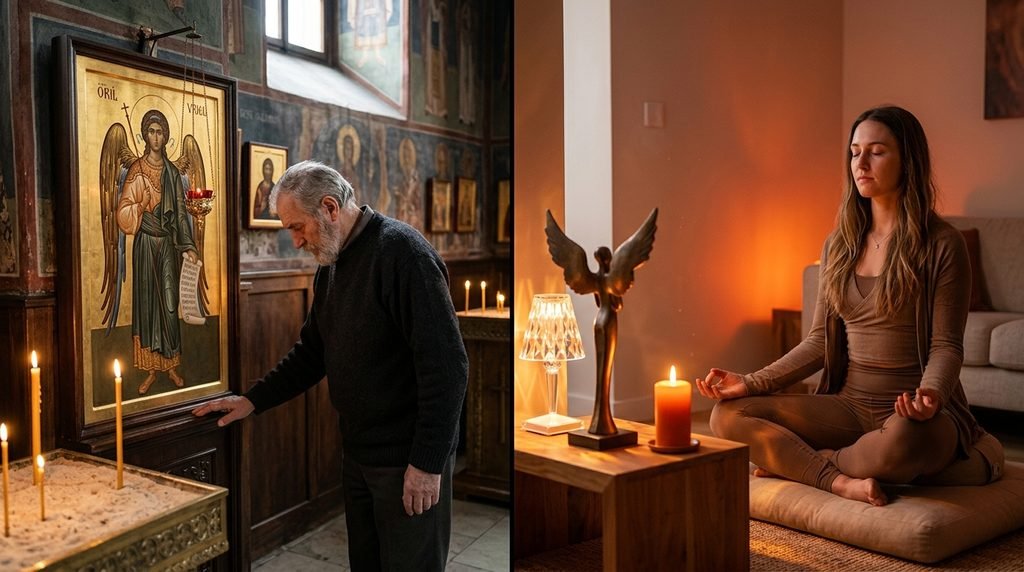
Outside the academic study of ancient apocalyptic literature, devotion to Uriel today survives in a few distinct settings. He retains a small but genuine place of honor in certain Eastern Orthodox and Coptic traditions, where devotional recognition of him predates the Western Church's formal rejection and was never fully abandoned in those communities. Far more commonly, however, he appears within contemporary, eclectic spiritual practices grouped under the broad label of New Age spirituality, where he is frequently invoked during meditation and associated with the color deep red or orange, symbolizing fire and illumination.
| Context | How Uriel Is Approached |
|---|---|
| Ancient Apocalyptic Literature | Studied within the Book of Enoch and 2 Esdras as a major angelic figure |
| Certain Eastern Traditions | Retains limited devotional recognition in some Orthodox and Coptic practice |
| Contemporary Spirituality | Invoked in meditation, often linked to fire, red or orange light |
| Roman Catholic Practice | Formally excluded since the Council of Rome in 745 |
Uriel Compared to the Three Recognized Archangels
For readers approaching this topic from a Catholic or Christian background, this comparison should clarify exactly where Uriel stands relative to the angels named directly in Scripture.
| Figure | Named in Canonical Scripture | Recognized by the Catholic Church |
|---|---|---|
| Michael | Yes (Daniel, Jude, Revelation) | Yes, with a feast day and approved prayers |
| Gabriel | Yes (Daniel, Luke) | Yes, with a feast day and approved prayers |
| Raphael | Yes (Tobit) | Yes, with a feast day and approved prayers |
| Uriel | No (Enoch, 2 Esdras only) | No, explicitly rejected in 745 |

Recommended video
Frequently Asked Questions About the Prayer of Archangel Uriel (FAQ)
Below, we answer common questions about who Uriel is, where this figure comes from, and how the invocations associated with him are understood today.
1. Is Uriel mentioned in the Bible?
Not in the canonical Bible recognized by the Catholic Church. Uriel appears in the Book of Enoch and 2 Esdras, two ancient Jewish texts considered apocryphal rather than part of the Old or New Testament canon.
2. Is there a genuine Catholic prayer to Archangel Uriel?
No. The Catholic Church does not recognize Uriel as an archangel, and his name was explicitly rejected by the Council of Rome in 745. Catholics seeking angelic intercession are better served by the prayers to Michael, Gabriel, and Raphael, the only three angels named in canonical Scripture.
3. What does the name Uriel mean?
The name is generally understood to mean "God is my light" or "Fire of God," combining the Hebrew root for light or fire with the divine name El. This meaning of illumination runs through nearly every text that describes him.
4. Why did the Church specifically reject Uriel by name?
The Council of Rome in 745, convened under Pope Zachary, addressed the practice of invoking angels drawn from apocryphal texts rather than canonical Scripture. Uriel was named specifically among those excluded, reflecting concern that devotion based on non-biblical sources could lead the faithful away from Church-approved teaching.
5. What role does Uriel play in the Book of Enoch?
In the Book of Enoch, Uriel serves as the patriarch Enoch's guide through visionary journeys across the heavens, explaining cosmic order and, in some passages, overseeing the realm of punishment for fallen angels.
6. Are the prayers to Uriel ancient or modern?
The texts describing Uriel himself are genuinely ancient, but no ancient or Church-approved prayer to him exists for devotional use. The invocations shared today, including those in this guide, are contemporary compositions written in the spirit of the themes historically associated with his name.
7. Does any Christian tradition still honor Uriel?
Some Eastern Orthodox and Coptic communities retain limited devotional recognition of Uriel, predating the Western Church's formal rejection of his name in 745. This recognition was never adopted within Roman Catholic teaching.
8. Why is Uriel associated with the color red or orange?
In contemporary spiritual practice, Uriel is frequently linked to deep red or orange light, symbolizing fire and illumination, drawing directly on the meaning of his name. This specific color association comes from modern devotional literature rather than the ancient texts that first describe him.
9. Who typically practices devotion to Uriel today?
Outside a small number of Eastern Christian communities and the academic study of ancient apocalyptic literature, devotion to Uriel today is found mainly within contemporary, eclectic spiritual practices grouped under the broad label of New Age spirituality.
10. If I want wisdom and guidance within a Catholic framework, who should I pray to instead?
Within Catholic tradition, Saint Gabriel the Archangel is closely associated with clarity and understanding, having delivered God's message to Mary, while the Holy Spirit is traditionally invoked directly for wisdom and discernment. Both offer a well-established alternative for anyone seeking guidance within a Christian framework.
Si quieres conocer otros artículos parecidos a Prayer of Archangel Uriel: Meaning, Origins & Invocations for protection, wisdom & exams puedes visitar la categoría Archangels.