
Glory Be to the Father Prayer: Complete Catholic Guide to History, Meaning, and Recitation
The Glory Be to the Father prayer—historically designated in Latin liturgical tradition as the Gloria Patri or the Minor Doxology—stands as one of the most fundamental, widely recited prayers in Christian worship. Spoken daily by millions of Catholic, Anglican, Orthodox, and Protestant faithful across the globe, this short yet profound hymn of praise proclaims the eternal majesty, co-equal dignity, and unceasing unity of the Holy Trinity: Father, Son, and Holy Spirit.
Whether recited at the end of each Psalm in the Liturgy of the Hours, prayed between decades of the Holy Rosary, or used as a personal breath prayer during moments of daily thanksgiving, understanding the biblical foundations, historical development, line-by-line meaning, and multilingual texts of the Glory Be deepens every believer's spiritual connection with the Triune God.
- Historical Development of the Gloria Patri
- The Complete English Text of the Glory Be Prayer
- Line-by-Line Meaning and Theological Breakdown
- Scriptural Roots: Where Doxologies Appear in the Bible
- Multilingual Translations: Latin and Spanish
- The Essential Role of the Glory Be in Catholic Devotions
- Recommended video
- Frequently Asked Questions About the Glory Be Prayer (FAQ)
Historical Development of the Gloria Patri
Where did the Glory Be originate? The origins of the Minor Doxology trace back to the earliest centuries of the Church, growing directly out of the baptismal mandate given by Jesus Christ in the Gospel of Saint Matthew: "Go therefore and make disciples of all nations, baptizing them in the name of the Father and of the Son and of the Holy Spirit" (Matthew 28:19).
Key Milestones in the History of the Glory Be
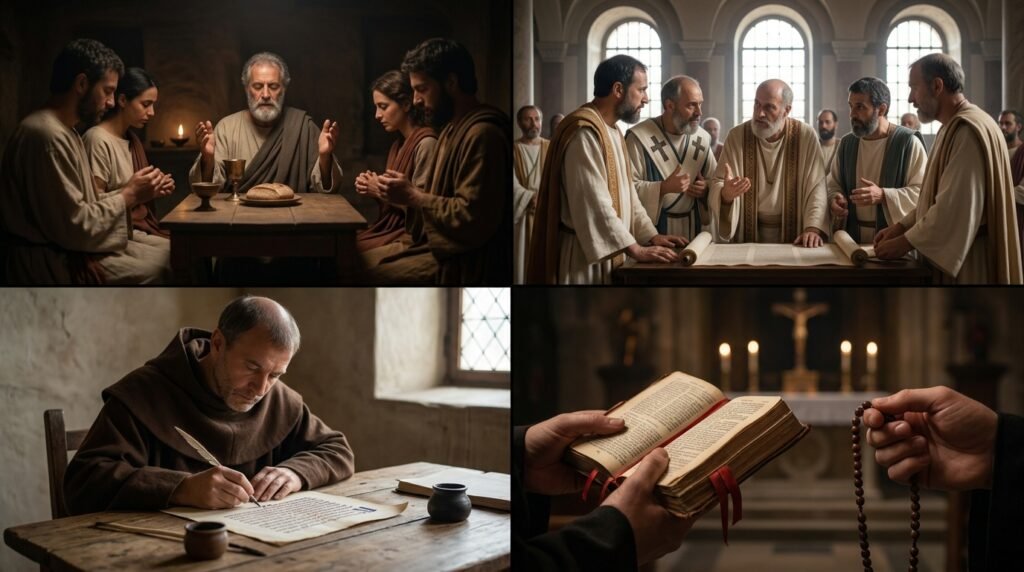
1st–3rd Century (Early Apostolic Doxologies): Early Christians routinely ended prayers with short praise to God through Jesus in the Holy Spirit, reflecting New Testament epistles.
4th Century (Anti-Arian Council Clarification): To combat Arianism (which denied Christ's full divinity), the Church formally affirmed that equal glory is given to the Son and the Spirit alongside the Father.
529 AD (Council of Vasa): The Western Church officially mandated the addition of "as it was in the beginning" to emphasize the eternal, uncreated co-existence of all three Divine Persons.
6th Century to Present: Fixed as a fundamental conclusion to every Psalm in the Western Divine Office (Liturgy of the Hours) and daily Rosary devotions.
During the fourth-century Trinitarian controversies, heretical groups such as the Arians altered prayer endings to suggest that the Son and Holy Spirit were lesser created beings subordinate to the Father. In response, early Church Fathers like Saint Athanasius and Saint Basil the Great defended the traditional formula: "Glory be to the Father, and to the Son, and to the Holy Spirit." This precise wording established that all three Persons share one identical divine nature, power, and glory.
The Complete English Text of the Glory Be Prayer
Below is the complete, official English text of the Glory Be as prayed across Catholic liturgy, traditional prayer books, and daily family devotions.
Traditional English Version (Catholic Liturgical Text)
Glory be to the Father, and to the Son, and to the Holy Spirit,
as it was in the beginning, is now, and ever shall be, world without end. Amen.
Line-by-Line Meaning and Theological Breakdown
Although brief, every single phrase within the Glory Be prayer encapsulates essential Christian dogmas regarding the Holy Trinity, divine eternity, and cosmic salvation history.
| Phrase | Theological Focus | Deeper Spiritual Meaning |
|---|---|---|
| "Glory be to the Father" | First Person of the Holy Trinity | Proclaims adoration to God the Father, the unbegotten origin and source of all divinity and creation |
| "And to the Son" | Second Person of the Holy Trinity | Affirms equal worship to Jesus Christ, the eternally begotten Word (*Logos*) made flesh for our redemption |
| "And to the Holy Spirit" | Third Person of the Holy Trinity | Honors the Holy Spirit, the Lord and Giver of Life, who proceeds from the Father and the Son |
| "As it was in the beginning" | Divine Pre-Existence & Creation | Reminds us that God’s glory existed before time, before creation, and from all eternity (*Genesis 1:1*) |
| "Is now" | Present Grace & Providence | Acknowledges God’s active reign, mercy, and presence in our personal lives and world today |
| "And ever shall be" | Eschatological Hope | Confirms our unshakable faith in God's eternal victory, unchanged by earthly trials or human opposition |
| "World without end. Amen." | Eternity (*In Saecula Saeculorum*) | Translates the Latin phrase for age upon age; *Amen* seals the prayer with "So be it" |
Scriptural Roots: Where Doxologies Appear in the Bible
While the precise wording of the Glory Be was codified by the Church, its structure directly mirrors biblical praise scattered throughout both the Old and New Testaments.
Biblical Foundations of Trinitarian Praise
1. Romans 11:36: "For from him and through him and to him are all things. To him be glory forever. Amen." Saint Paul anchors all created reality in giving glory to God.
2. Ephesians 3:21: "To him be glory in the church and in Christ Jesus throughout all generations, forever and ever. Amen." Demonstrates that glory is given across every era of time.
3. Jude 1:25: "To the only God, our Savior, through Jesus Christ our Lord, be glory, majesty, dominion, and authority, before all time and now and forever. Amen." Mirrors the temporal structure: past (*before all time*), present (*now*), and future (*forever*).
4. Revelation 4:8: "Holy, holy, holy, is the Lord God Almighty, who was and is and is to come!" The heavenly liturgy continuously worships the eternal, unchanging nature of God.
Multilingual Translations: Latin and Spanish
Praying the Glory Be in Latin or Spanish connects believers to centuries of sacred tradition and international Catholic unity.
1. Latin Text (Gloria Patri)
Gloria Patri, et Filio, et Spiritui Sancto,
sicut erat in principio, et nunc, et semper, et in saecula saeculorum. Amen.
2. Spanish Text (Gloria al Padre)
Texto Completo en Español
Gloria al Padre, y al Hijo, y al Espíritu Santo,
como era en el principio, ahora y siempre, por los siglos de los siglos. Amén.
The Essential Role of the Glory Be in Catholic Devotions
The Glory Be serves as a pivotal structural prayer in liturgical and private Catholic prayer traditions.
Key Devotional Applications of the Glory Be
1. The Holy Rosary: Prayed at the conclusion of each decade following the ten Hail Marys. It seals the meditation on each Gospel mystery by directing all praise to the Trinity before reciting the Fatima Prayer.
2. The Liturgy of the Hours (Divine Office): Recited at the end of every single Psalm and Canticle during Morning Prayer (Lauds), Evening Prayer (Vesper), and Night Prayer (Compline), Christifying the Old Testament Psalms.
3. The Triplet Sequence (Our Father, Hail Mary, Glory Be): Forms the standard foundational cluster of Catholic prayers offered for specific intentions, novenas, or papal intercessions.
4. Personal Aspirations: Recited spontaneously throughout the day as an act of thanksgiving upon receiving good news or overcoming temptation.
Recommended video
Frequently Asked Questions About the Glory Be Prayer (FAQ)
Below, we answer common questions regarding the biblical roots, liturgical history, and spiritual meaning of the Glory Be prayer.
1. Why is the Glory Be called the "Minor Doxology"?
The glory be to the father prayer is called the Minor Doxology (or Lesser Doxology) to distinguish it from the Major Doxology, which is the Gloria in Excelsis Deo ("Glory to God in the highest") sung during Sunday Holy Mass.
2. Where is the Glory Be found in the Bible?
While the exact wording of the glory be in the bible developed through early Church liturgy, its individual components reflect Scripture directly. The baptismal formula comes from Matthew 28:19, and its temporal structure ("as it was in the beginning...") reflects Paul's doxologies in Romans 11:36 and Ephesians 3:21.
3. What does "world without end" mean in the prayer?
The traditional phrase "world without end" is an old English translation of the Latin in saecula saeculorum (literally "unto ages of ages"). It does not refer to the physical planet earth, but rather to eternity—expressing that God's glory endures forever and ever without boundary or end.
4. How is the Glory Be used in the Catholic Rosary?
In the glory be to the father rosary structure, the prayer is recited on the chain or single bead following the ten Hail Marys of each decade. It re-centers the meditator's mind on the Holy Trinity after contemplating the Gospel mystery.
5. What is the difference between Catholic and Eastern Orthodox versions of the Glory Be?
In Western Catholic tradition, the prayer includes "as it was in the beginning, is now, and ever shall be." In Eastern Orthodox tradition, the Greek formula usually reads: "Glory to the Father, and to the Son, and to the Holy Spirit, both now and ever, and unto the ages of ages. Amen." Both versions proclaim the eternal glory of the Triune God.
6. What is the meaning of "Soli Deo Gloria"?
The Latin phrase to god alone be the glory (Soli Deo Gloria) expresses the fundamental Christian truth that all honor, praise, and ultimate credit for creation, salvation, and blessings belong exclusively to God.
Si quieres conocer otros artículos parecidos a Glory Be to the Father Prayer: Complete Catholic Guide to History, Meaning, and Recitation puedes visitar la categoría Prayers.