
The Prayer of Saint Francis of Assisi: Full Text, True Origins & How to Pray

Few names in Christian history carry the same immediate warmth as Francis of Assisi. Nearly everyone, Catholic or not, recognizes something of his spirit in the words "Lord, make me an instrument of your peace," words printed on countless plaques, sung in countless hymns, and recited at funerals, ordinations, and peace vigils across every continent. Yet the story behind this beloved prayer, and behind the man most people believe wrote it, is more surprising than most readers expect.
This guide brings together everything worth knowing about the prayers associated with Saint Francis: the full text of the world-famous Peace Prayer and the true, documented story of where it actually came from, the authentic prayer Francis himself composed before the crucifix at San Damiano, his genuine Canticle of the Creatures, prayers for animals and pets connected to his enduring patronage of creation, the Franciscan Crown Rosary honoring the Seven Joys of Mary, and the Spanish text of his most famous prayer. Everything here distinguishes carefully between what Francis actually wrote and what later devotion, however beautiful, has attributed to him.
In Short
The famous "Peace Prayer of St. Francis" was not written by him; it first appeared anonymously in a French magazine in 1912. His authentic prayers include the short Prayer Before the Crucifix and the Canticle of the Creatures, both documented in his own writings, and his feast day, October 4, remains closely tied to the traditional Blessing of Animals.
-
Who Was Saint Francis of Assisi?
- The Peace Prayer of St. Francis: Full Text
- Is the Peace Prayer Really by St. Francis? The True Origin
- The Prayer Before the Crucifix: Saint Francis's Authentic Prayer
- The Canticle of the Creatures: Saint Francis's Authentic Hymn
- Saint Francis Prayers for Animals and Pets
- The Franciscan Crown Rosary: The Seven Joys of Mary
- Saint Francis's Feast Day and Prayer
- The Peace Prayer in Spanish (Oración de la Paz de San Francisco)
- Recommended video
- Frequently Asked Questions About the Prayer of Saint Francis (FAQ)
Who Was Saint Francis of Assisi?
Born Giovanni di Pietro di Bernardone around 1181 in the Italian town of Assisi, Francis was the son of a wealthy cloth merchant, raised for a life of comfort and eventually military ambition. A serious illness following a year as a prisoner of war, and a series of unsettling encounters, including a formative moment kneeling before the crucifix in the crumbling church of San Damiano, gradually turned him away from wealth and toward a radical embrace of poverty, simplicity, and service to the poor.
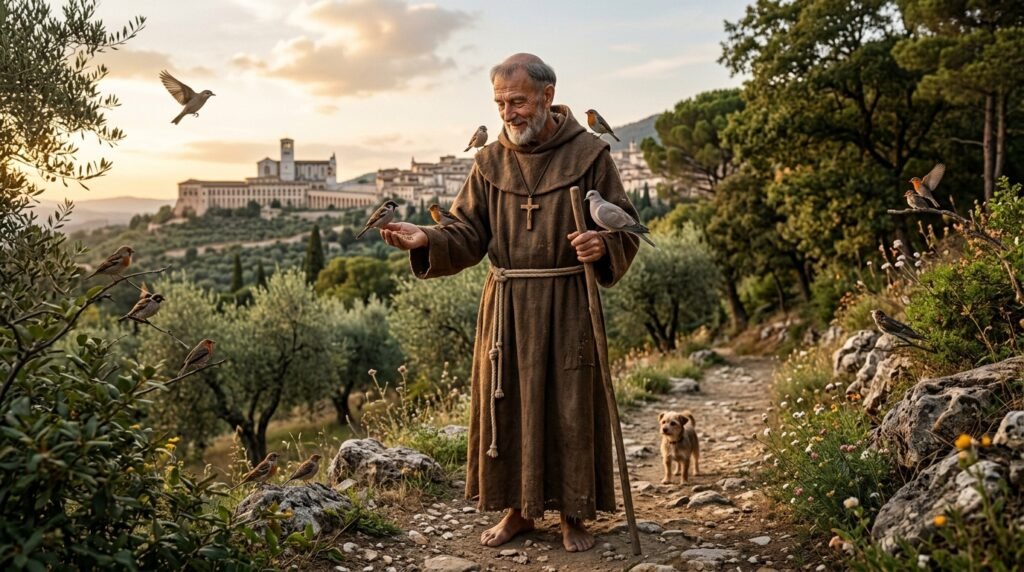
He founded what became the Franciscan Order, a community of friars committed to living without property, and he is remembered for a deep, almost startling tenderness toward the natural world, famously preaching to birds and negotiating peace with a wolf terrorizing the town of Gubbio, according to tradition. He died in 1226 and was canonized just two years later, in 1228, remarkably quickly even by the standards of his era. Today he is honored as the patron saint of animals, ecology, and Italy itself, and his feast day, October 4, remains one of the most widely celebrated in the Catholic calendar.
The Peace Prayer of St. Francis: Full Text
This is the prayer nearly everyone recognizes, whether or not they know its real history. It is reproduced here in full.
Lord, make me an instrument of your peace.
Where there is hatred, let me sow love;
where there is injury, pardon;
where there is doubt, faith;
where there is despair, hope;
where there is darkness, light;
and where there is sadness, joy.
O Divine Master, grant that I may not so much seek
to be consoled as to console;
to be understood as to understand;
to be loved as to love.
For it is in giving that we receive;
it is in pardoning that we are pardoned;
and it is in dying that we are born to eternal life. Amen.
Is the Peace Prayer Really by St. Francis? The True Origin
Here is something worth knowing before praying these words again: no serious historian or Franciscan scholar today believes Saint Francis wrote this prayer. It does not appear anywhere in his authentic writings, and it cannot be traced back further than December 1912, nearly seven centuries after his death, when it appeared anonymously in a small French spiritual magazine called La Clochette (The Little Bell), published in Paris under the title "A Beautiful Prayer to Say During Mass."
The likely author was Father Esther Bouquerel, the priest who edited the magazine, though even that remains unconfirmed. The prayer gained wider attention when it was sent to Pope Benedict XV in 1915 and published in Italian in the Vatican newspaper L'Osservatore Romano the following year. Its connection to Francis appears to have begun almost by accident: around 1920, a French Franciscan priest printed the prayer on the back of a holy card bearing an image of Saint Francis, and over the following years, particularly as the prayer spread through peace movements between the two World Wars, people naturally assumed the saint pictured on the front had written the words on the back.
| Detail | Fact |
|---|---|
| First Documented | December 1912, in the French magazine La Clochette |
| Original Title | "Belle prière à faire pendant la Messe" (A Beautiful Prayer to Say During Mass) |
| Likely Author | Possibly Father Esther Bouquerel, the magazine's editor, though unconfirmed |
| Link to Francis | Attributed to him after being printed on holy cards bearing his image, circa 1920 |
This history does not make the prayer any less beautiful, and it remains a cherished part of Christian devotion, formally titled "A Prayer Attributed to St. Francis" in many official prayer books today. It simply means that when this prayer is placed alongside his genuine writings, a real difference in tone and focus becomes noticeable, one worth exploring in the authentic prayers below.
The Prayer Before the Crucifix: Saint Francis's Authentic Prayer
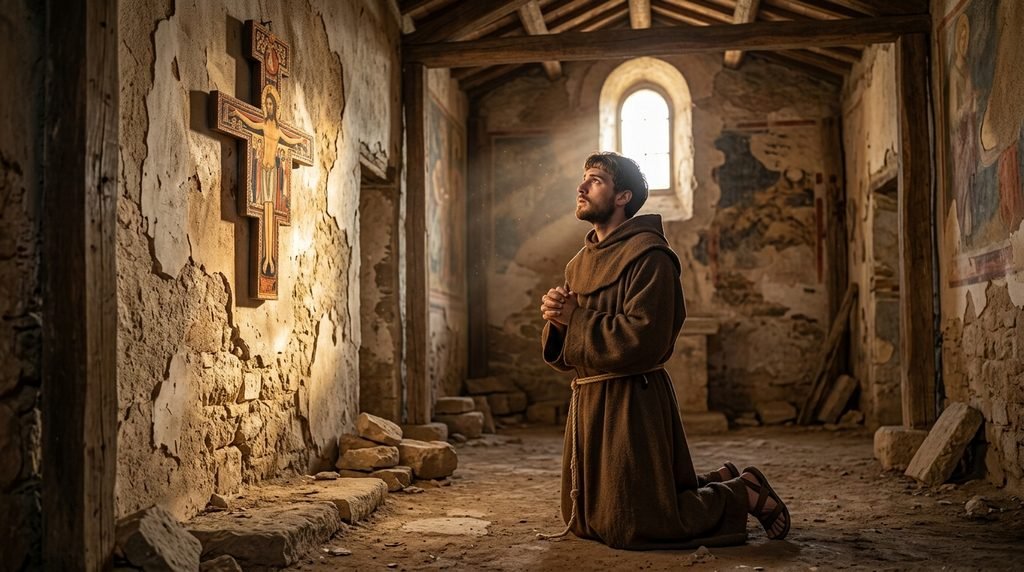
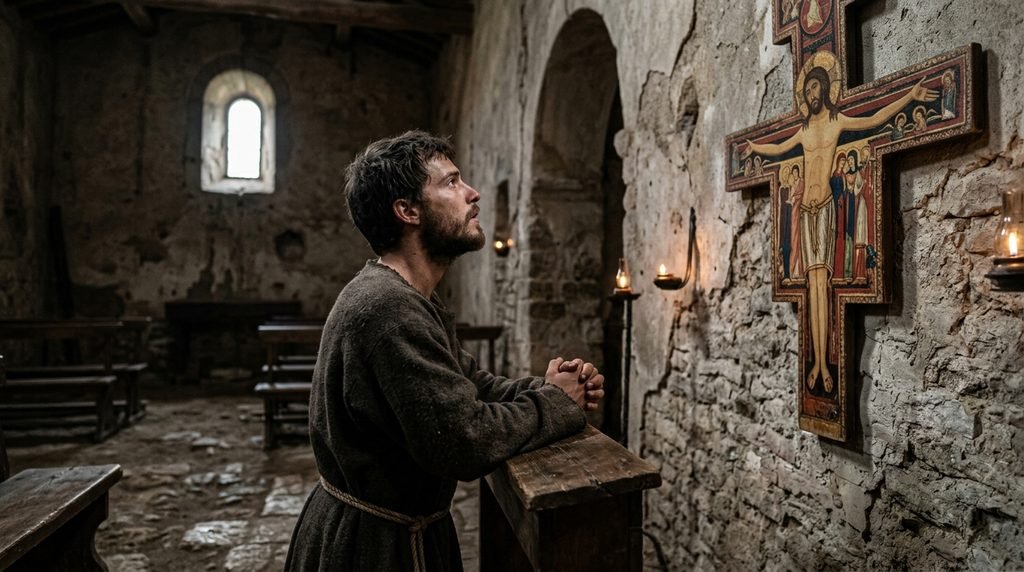
Unlike the Peace Prayer, this short prayer is genuinely his, documented in the earliest biographical sources and preserved in the critical editions of his writings. Tradition places it in his own mouth as he knelt before the crucifix in the small, crumbling church of San Damiano, just outside Assisi, in a moment that marked the beginning of his conversion. The crucifix he prayed before, known today as the San Damiano Cross, remains one of the most recognizable images in Franciscan spirituality.
Documented in the earliest critical editions of Francis's own writings.
Most High, glorious God, enlighten the darkness of my heart, and give me true faith, certain hope, and perfect charity, sense and knowledge, Lord, that I may carry out Your holy and true command. Amen.
This brief prayer, only a single sentence, has become one of the most quietly influential in Franciscan spirituality, precisely because of its restraint. It does not ask for anything material; it asks only for the interior clarity to see and follow God's will, a theme that would define the rest of Francis's life.
The Canticle of the Creatures: Saint Francis's Authentic Hymn
Composed in the final years of his life, when illness had left him nearly blind, the Canticle of the Creatures, also called the Canticle of Brother Sun, stands as Francis's most celebrated original work and one of the earliest known pieces of literature written in the Italian vernacular rather than Latin. It is a hymn of praise addressed to God through the created world, treating the sun, moon, wind, water, fire, and earth as brothers and sisters, each reflecting something of their Creator.
An authentic composition by Francis, from the final years of his life.
Most High, all-powerful, good Lord, all praise is Yours, all glory, all honor, and all blessing.
Praised be You, my Lord, with all Your creatures, especially Brother Sun, who is the day and through whom You give us light. And he is beautiful and radiant with great splendor, and bears a likeness of You, Most High.
Praised be You, my Lord, through Sister Moon and the stars, in heaven You formed them, clear and precious and beautiful.
Praised be You, my Lord, through Brother Wind, and through the air, cloudy and serene, and every kind of weather, through whom You give sustenance to Your creatures.
Praised be You, my Lord, through Sister Water, who is very useful and humble and precious and chaste.
Praised be You, my Lord, through Brother Fire, through whom You light the night, and he is beautiful and playful and robust and strong.
Praised be You, my Lord, through our Sister Mother Earth, who sustains and governs us, and who produces varied fruits with colored flowers and herbs.
Praise and bless my Lord, and give Him thanks, and serve Him with great humility. Amen.
Francis later added further verses honoring those who forgive for love of God and, in his final days, verses welcoming "Sister Bodily Death," making the Canticle not only a hymn of creation but a meditation on the whole span of life, ending in peace with death itself.
Saint Francis Prayers for Animals and Pets
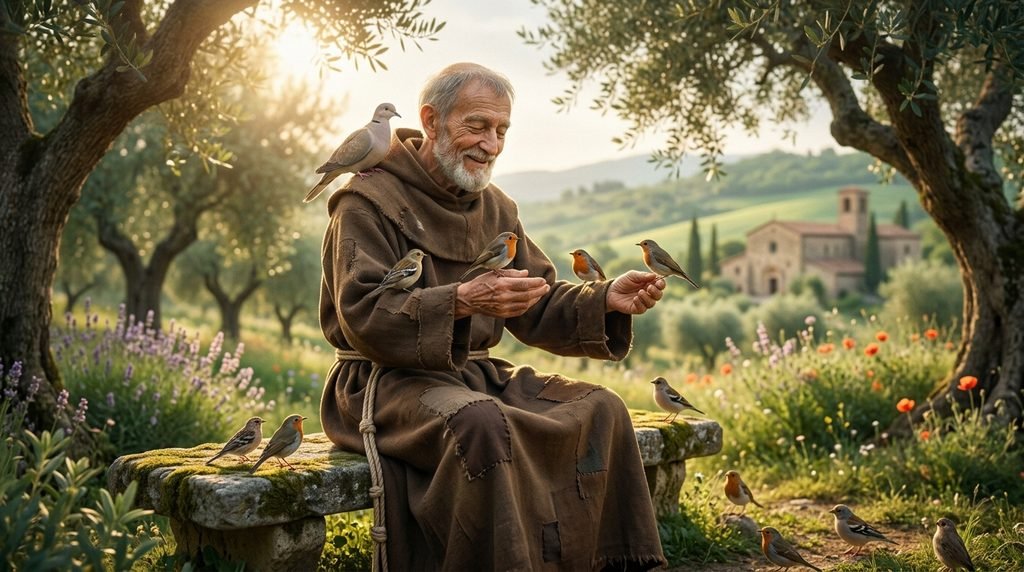
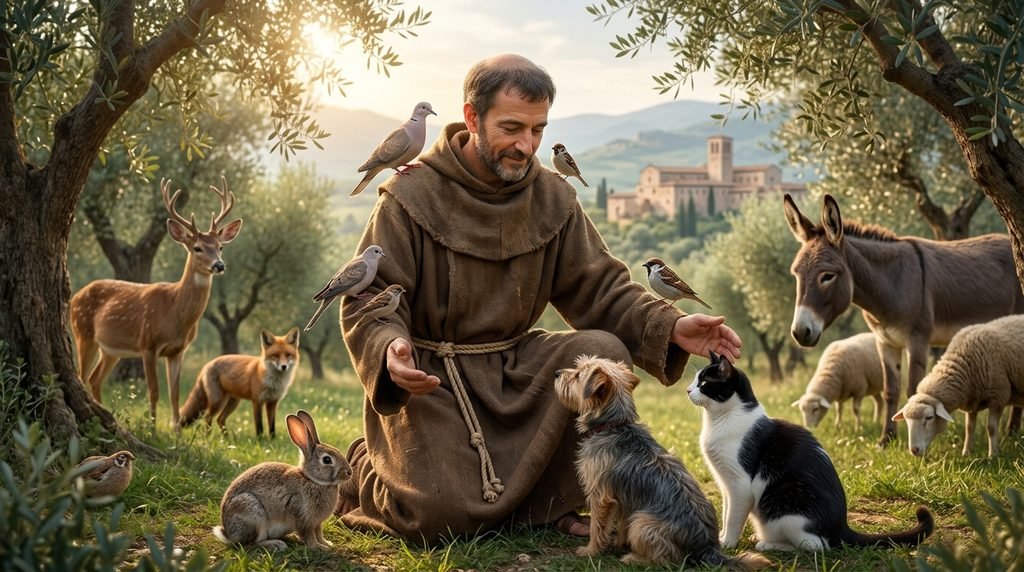
Because of his deep and well-documented love for animals, expressed in stories of preaching to birds, taming the wolf of Gubbio, and treating every creature as a brother or sister, Francis remains the patron saint of animals, and October 4 is marked at churches around the world by the Blessing of Animals, when parishioners bring their pets to be blessed.
It is worth being honest here as well: the prayer most commonly used at these blessing services today, often shared online as "the St. Francis prayer for animals," is a modern liturgical composition, written in the spirit of his love for creation rather than a text found in his own surviving writings. It remains a beautiful and entirely appropriate prayer to use; it is simply not, strictly speaking, something Francis himself composed.
A modern liturgical prayer commonly used at Blessing of Animals services, written in the spirit of Francis's love for creation.
Blessed are You, Lord God, maker of all living creatures. You called forth fish in the sea, birds in the air, and animals on the land. You inspired Saint Francis to call all of them his brothers and sisters. We ask You to bless this pet. By the power of Your love, enable it to live according to Your plan. May we always praise You for all Your beauty in creation. Blessed are You, Lord our God, in all Your creatures. Amen.
For more specific needs, these shorter devotional prayers, composed in the same spirit, can be adapted for particular pets and situations.
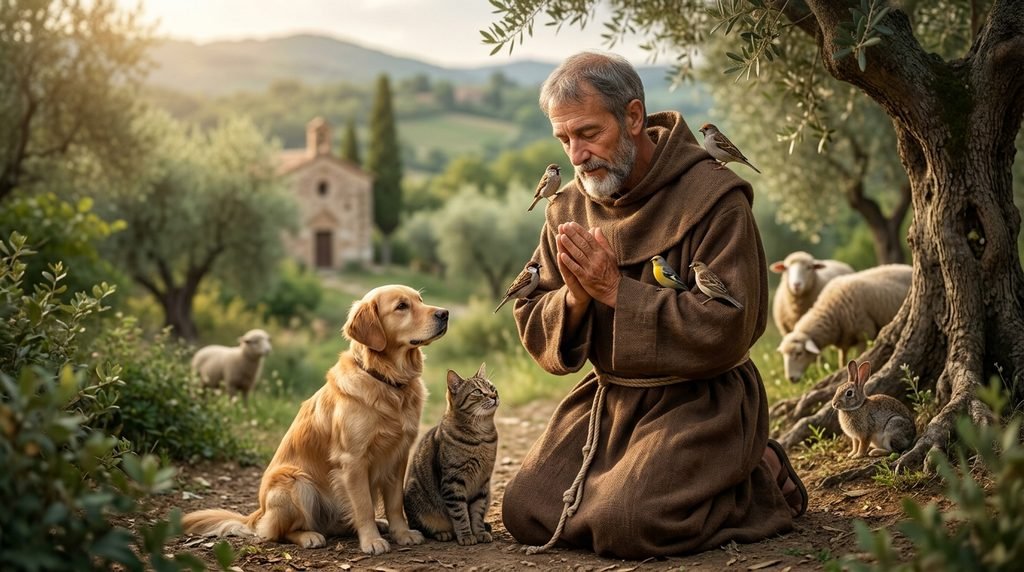
For a Dog
Lord, bless my faithful companion, whose loyalty asks for nothing in return. Keep him healthy and joyful, and thank You for the simple, steady love he brings into my home. Amen.
For a Cat
Lord, bless my quiet companion, whose independence and affection both remind me that love takes many forms. Watch over her, and thank You for the comfort she brings simply by being near. Amen.
For a Sick Pet
Lord, my companion is unwell, and I ask for healing according to Your will. Guide the hands of the veterinarian caring for them, ease their discomfort, and give me the patience to care for them well through this illness. Amen.
For a Lost Pet
Lord, my companion is lost, and I am frightened for them. Guide them safely home, or guide someone kind to find them, and give me hope rather than despair while I search. Amen.
The Franciscan Crown Rosary: The Seven Joys of Mary
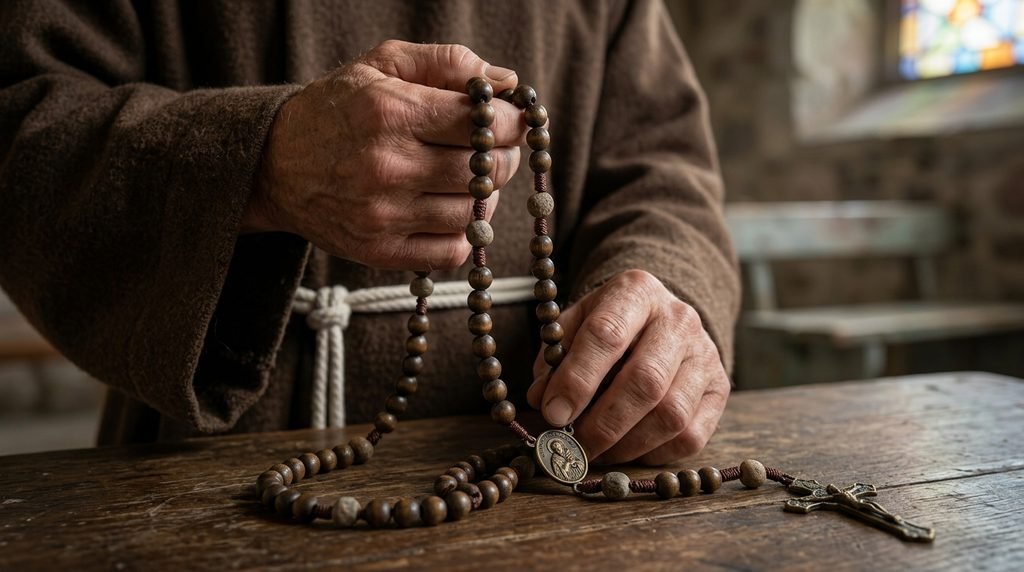
Distinct from the standard Holy Rosary, the Franciscan Crown, also called the Seraphic Rosary, is a devotion specific to the Franciscan tradition, tracing back to 1422. According to the account preserved by Franciscan historians, a young novice who had once decorated a statue of Mary with fresh flowers grew discouraged when this practice was no longer permitted after he entered religious life. In a vision, Mary herself instructed him to weave a different kind of crown, seven decades of Hail Marys honoring seven joyful moments of her life, which would please her far more than flowers that quickly withered.
| Decade | Joy of Mary |
|---|---|
| First | The Annunciation |
| Second | The Visitation |
| Third | The Nativity of Jesus |
| Fourth | The Adoration of the Magi |
| Fifth | The Finding of Jesus in the Temple |
| Sixth | The Resurrection of Jesus |
| Seventh | The Assumption and Coronation of Mary |
How to Pray It
Begin with the Apostles' Creed, followed by one Our Father and three Hail Marys. Then, for each of the seven joys above, announce the mystery and pray one Our Father and ten Hail Marys. After the seventh decade, pray two additional Hail Marys, bringing the total to seventy-two, traditionally said to represent the number of years the Blessed Virgin lived on earth. In later Franciscan practice, one final Our Father and Hail Mary were also added for the intentions of the Pope. Many pray this crown add a Glory Be after each decade, though this is optional, and close the devotion with the Hail Holy Queen, the same prayer used to close the standard Rosary.
Saint Francis's Feast Day and Prayer
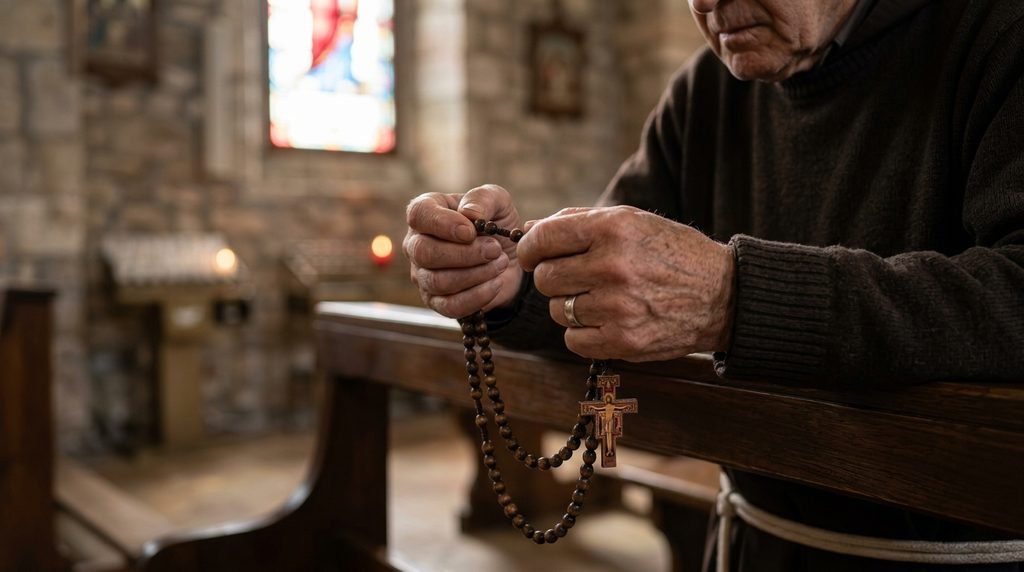
Every year on October 4, the Church celebrates the feast of Saint Francis of Assisi, a day marked in many parishes by the Blessing of Animals and by a renewed focus on simplicity, peace, and care for creation.
Saint Francis, on your feast day, help us live more simply, love more freely, and see God's presence in every creature You once called brother and sister. Teach us your peace, not as an idea to admire, but as a way to actually live. Saint Francis, pray for us. Amen.
The Peace Prayer in Spanish (Oración de la Paz de San Francisco)
For Spanish-speaking readers, or anyone searching for "oracion de San Francisco de Asis," this is the widely used Spanish version of the same prayer, prayed in parishes throughout the Spanish-speaking world.
Señor, hazme un instrumento de tu paz.
Donde haya odio, ponga yo amor;
donde haya ofensa, perdón;
donde haya discordia, unión;
donde haya duda, fe;
donde haya error, verdad;
donde haya desesperación, esperanza;
donde haya tristeza, alegría;
donde haya tinieblas, luz.
Oh, Maestro, haz que yo no busque tanto ser
consolado, como consolar;
ser comprendido, como comprender;
ser amado, como amar.
Porque es dando, que se recibe;
perdonando, que se es perdonado;
y muriendo, que se resucita a la vida eterna. Amén.
Recommended video
Frequently Asked Questions About the Prayer of Saint Francis (FAQ)
Below, we answer common questions about the prayers associated with Saint Francis, their true origins, and how they are used today.
1. Did Saint Francis of Assisi really write the Peace Prayer?
No. The Peace Prayer of St. Francis, beginning "Lord, make me an instrument of your peace," first appeared anonymously in a French magazine in 1912, nearly seven centuries after his death. It does not appear anywhere in his authentic writings and was only attributed to him decades later, likely by accident.
2. What is Saint Francis's actual, authentic prayer?
His most well-documented authentic prayer is the short Prayer Before the Crucifix, traditionally prayed at the San Damiano crucifix, beginning "Most High, glorious God, enlighten the darkness of my heart." His Canticle of the Creatures is also a genuine, well-documented composition from the final years of his life.
3. Why is Saint Francis the patron saint of animals?
Tradition credits Francis with a deep tenderness toward all creatures, including famous stories of preaching to birds and taming the wolf of Gubbio. This reputation led the Church to name him the patron saint of animals and ecology, and it is why churches hold Blessing of Animals services on his feast day.
4. Did Francis write the prayer used for blessing pets?
Not directly. The prayer commonly used today at St. Francis prayer for animals services is a modern liturgical composition, written in the spirit of his love for creation, rather than a text found in his own surviving writings.
5. What is the Canticle of the Creatures?
The Canticle of the Creatures, also called the Canticle of Brother Sun, is Francis's authentic hymn of praise to God through creation, composed near the end of his life. It is considered one of the earliest works of Italian literature and remains his most celebrated original composition.
6. What is the Franciscan Crown Rosary?
The Franciscan Crown, also called the Seraphic Rosary, is a seven-decade devotion honoring the Seven Joys of Mary, dating to a vision reported in 1422. It differs from the standard five-decade Rosary and concludes with two additional Hail Marys, totaling seventy-two, in honor of Mary's traditional lifespan.
7. When is the feast day of Saint Francis of Assisi?
His feast is celebrated on October 4 each year, commonly marked by the Blessing of Animals in parishes around the world, when pets are brought to church to receive a blessing in his honor.
8. Is it still appropriate to pray the Peace Prayer even though Francis didn't write it?
Yes. Many official prayer books now label it "A Prayer Attributed to St. Francis," acknowledging its uncertain authorship while preserving its widespread use. Its message of humility and self-giving love reflects his spirit closely, even if the specific words came from another author.
9. Who actually wrote the Peace Prayer, if not Francis?
The true author remains unconfirmed. It was first published anonymously in 1912 in the French magazine La Clochette, and researchers believe the editor, Father Esther Bouquerel, may have written it, though this has never been definitively established.
10. Is the Prayer of Saint Francis available in Spanish?
Yes. The Oración de la Paz de San Francisco is widely prayed in Spanish-speaking parishes and follows the same structure and meaning as the English version, "Señor, hazme un instrumento de tu paz."
Si quieres conocer otros artículos parecidos a The Prayer of Saint Francis of Assisi: Full Text, True Origins & How to Pray puedes visitar la categoría Saints.